Defiance
Mariners' Museum, Uncurated Search Results
Type: Skipjack
Year: 1908
Builder:
Location: Fairbank

These records are found in the online catalog of The Mariners’ Museum and Park in Newport News, Virginia. Uncurated search results are presented to give researchers and interested readers an idea of whether the museum’s archives contain information about this vessel and whether it may be worthwhile to visit the museum’s catalog search page for further investigation. Uncurated results may be inaccurate or incomplete.
Search mode: Exact Name. Search phrase(s): "Defiance". Results returned: 42. Results displayed in this table: 42.
Use these buttons to send uncurated search results to your own app or text document for further research. First, check the box for any row, or click "Select All" then uncheck any rows. Then click "Show Selections". You can then copy your selections from the text box and past them into your app.
| Fetch? | Row ID | Media | Date | Vessel | Place | Related Places | Inscription/Marks | Subject | Notes | Archive Number |
|---|---|---|---|---|---|---|---|---|---|---|
| 1 | No image URL. | Steamboats–History. Netherlands | PS Defiance : the first steamship in Holland. | LB41836 | ||||||
| 2 | No image URL. | Cassell military classics | Naval battles–History.; Naval history. | Originally published: London: Arms & Armour, 1995. Includes index. | LB81576 | |||||
| 3 | 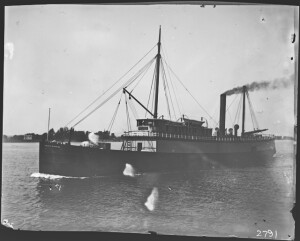 | 5/22/1897 | Defiance (Steamship : 1875). | Defiance; 2791 | Steamboats–United States. | Shows a port side view of a steamboat making way, black smoke trailing from her stack. Stanton's notebooks contain the following information about this item: "May 22 '97" | MS0094/01-#2791 | |||
| 4 | No image URL. | Contains black-and-white photographs. | MS0817/01-16.132 | |||||||
| 5 | No image URL. | Contains black-and-white photographs. | MS0817/01-19.052 | |||||||
| 6 | 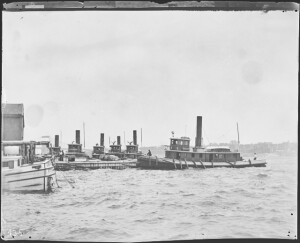 | 5/1894 | Defiance (Steamboat : 1883).; W. H. Bentley (Steamboat : 1880).; Meta (Steamboat : 1891).; James W. Husted (Steamboat : 1875).; Municipal (Steamboat : 1880).; F. W. Devoe (Steamboat : 1870). | Defiance - (tug); 435 | Steamboats–United States.; Tugboats–United States. | Shows six tugboats moored to the same pier. Stanton's notebooks contain the following information about this item: "May; 1894" | MS0094/01-#0435 | |||
| 7 |  | 10/9/1897 | Defiance (Steamboat : 1883).; Turban (Schooner : 1881). | Turban - (sch) - see - Defiance - (tug); 3005 | Steamboats–United States.; Tugboats–United States.; Schooners–United States.; Harbors–United States. | Shows a nearly head on view of the sterns of a schooner being pushed by a tugboat into a busy harbor. Stanton's notebooks contain the following information about this item: "Oct 9 1897" | MS0094/01-#3005 | |||
| 8 | 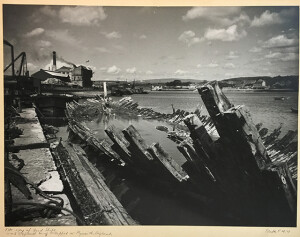 | on verso: stamped- Exhibition of Marine Photography 1950 | View of the shell of the H.M.S Defiance being scrapped in Plymouth, England. | P0025/03-#16 | ||||||
| 9 | 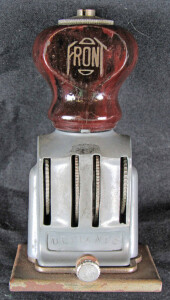 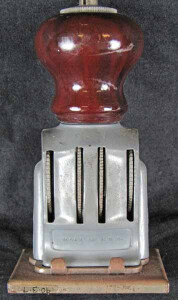 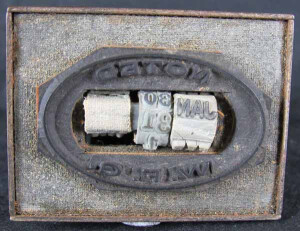 | SHORT DESCRIPTION: Die cast, two-piece metal housing with pressed metal base plate and turned wood handle. Rubber stamp under base produces impression. Changeable date controlled by knurled wheels. | CL23653 | |||||||
| 10 | 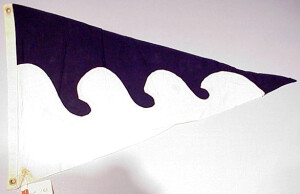 | SHORT DESCRIPTION: Triangular burgee divided horizontally by a wavy line, with half of the burge in blue fabric and the other in white fabric. There are two brass grommets on the hoist edge, one at each end of the webbing, for flying the burgee. | CL3381 | |||||||
| 11 | 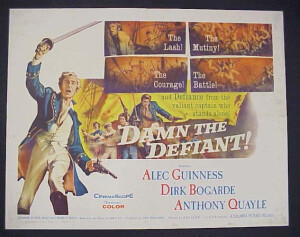 | DAMN THE DEFIANT | CL26802 | |||||||
| 12 | 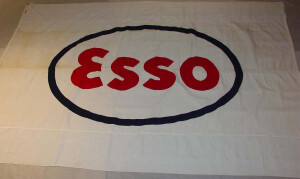 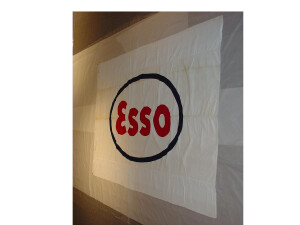 | SHORT DESCRIPTION: Esso Shipping Company house flag. White field with navy blue circle surrounding the work "Esso" which is red. NOTES: Flag and funnel marking first used in July 1937 on board the Esso Bayonne. | CL3438 | |||||||
| 13 | 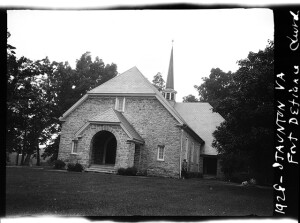 | 1928 | Augusta County (Va.). | 1928 - Staunton Va - Fort Defiance Church | Church buildings–Virginia–Augusta County. | Shows a church building made of stone, a woman is posed next to the entrance. In the caption Hungerford labels this negative as Staunton, but this church is in Augusta County outside the city. | MS0003/-002.2137#03769 | |||
| 14 | 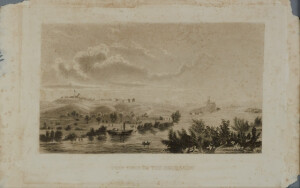 | SHORT DESCRIPTION: Black and white engraving showing the Colorado River and Fort Yuma. The remains of an old mission, La Purísima Concepción stand on the mesa to the left of the center. The sidewheel steamer General Jesup sits at the bank of Colorado River. NOTES: Penciled on bottom. Original, very rare. ADDITIONAL INFORMATION: See Steamboats on the Colorado River 1852 to 1916 by Richard E. Ligenfelter. Excerpts can be found in the object file. VESSEL HISTORY: The General Jesup was a small sidewheel steamboat used on the Colorado River to supply Fort Yuma. She had a 50-horsepower engine, measured 104 feet from stem to stern, and 17 feet at the beam--27 feet including her paddle guards--and carried 50 tons of cargo on only 30 inches of water. She was named after the US Quartermaster General Thomas Sidney Jesup. The vessel was owned by George Johnson, Ben Hartshorne and Captain Alfred H. Wilcox. It was transported, in sections, in the hold of the brig General Viel and then reassembled in the estuary of the Colorado River. She arrived at Fort Yuma with her first cargo on January 18, 1854. The vessel made round trips from the estuary to the fort in only four to five days with 50-ton cargos paying $75 a ton, a gross of nearly $4000 per trip, about $20000 a month during the busy season. General Jesup was used to determine if the river above Fort Yuma was passable by steamboats in early 1858 making it 300 miles upriver to the rapids. On January 23rd, 1858, while on the way back down the river they encountered Lt. Edward F. Beale and a caravan of camels. Beale was returning to the east after surveying a military wagon road from Fort Defiance in New Mexico to the western borders of California and investigating the use of camels in the place of mules. The General Jesup was used to ferry the animals across the river. [Edward Fitzgerald Beale by Stephen Bonsal, New York, G. Puntnam's Sons, 1912, page 227-228]. In 1859 the machinery was removed from the General Jesup and her was floated down and abandoned at Minturn Slough near Fort Yuma. The steamer General Jesup was the first to explore the Colorado River. | CL17873 | |||||||
| 15 | 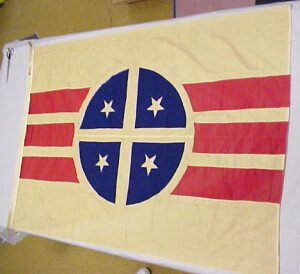 | SHORT DESCRIPTION: Rectangular flag with white background or field and three horizontal lines, each 5-1/2" in width, running across the flag in the center portion, each separated by a 2-1/2" section of the white background. These are broken creating a white roundel around a blue disc in the center of the flag, 29" in diameter. The disc is broken into four parts by two crossing white (background) lines. In each of the four segments of the disc is a white five pointed star, 4-1/2" each. | CL3467 | |||||||
| 16 | 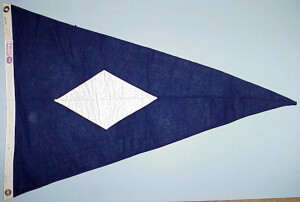 | SHORT DESCRIPTION: Dark blue, triangular burgee with white diamond or lozenge stitched on both sides, measuring 6" high and 10-3/8" wide. The tip of the fly edge is folded and stitched and there are two brass grommets, one near each end of the webbing, for flying the burgee. | CL4079 | |||||||
| 17 | 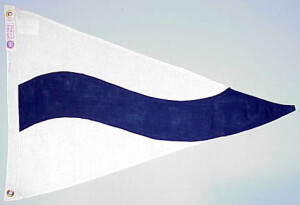 | SHORT DESCRIPTION: White, cotton burgee with wavy, navy blue strip across center horizontally and varying in thickness from 3-1/2" to 4-1/4" wide. There are two brass grommets at the hoist edge, one near each end of the webbing, for flying the burgee. | CL3387 | |||||||
| 18 | 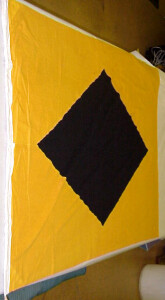 | SHORT DESCRIPTION: Gold, rectangular flag with a black diamond, or lozenge, in the center measuring 55" long and 35" wide. Rope is visible above and below the header at hoist edge. | CL4156 | |||||||
| 19 | 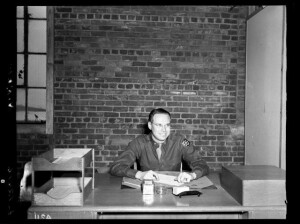 | 2/4/1945 | United States. Army–Officers. | Photo of Lt. Richard H. Bansen, 01945151, home, Defiance, Ohio. Lt. Bansen is connected with Army Exchange Oversea Supply Division, NAB, HRPE, Norfolk, Va. Photo taken for civilian orientation program. | Portrait of an officer sitting at his desk. This officer has a winning smile. Oddly much of the image is taken up by the behind him. | P0003/01-#E-12416 | ||||
| 20 | 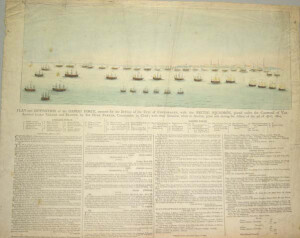 | SHORT DESCRIPTION: At the top of the engraving is a colored scene showing the layout of the Danish force as they prepared to protect the city against attack by the British fleet in 1801. The city of Copenhagen is visible behind the line of battle ships. All of the vessels are numbered and identifed. Under the scene are transcriptions of letters by Sir Hyde Parker and Colonel Henrik Stricker and an account of the battle with a list of those killed and wounded by Horatio Nelson. NOTES: Edward Riou was baptized in 1762 by his parents, Stephen and Dorothy Riou. He joined the Royal Navy at the age of 12 and served on two different ships before joining Captain Charles Clerke and HMS Discovery on February 22, 1776 as part of Captain James Cook’s third and final voyage to explore the Pacific. With his shipmate, William Bligh, Riou must have witnessed at least some small part of the interaction in February 1779 between Cook and the Hawaiians as the two sides clashed and Cook eventually lost his life. Riou kept a log while onboard, which described how Riou found a dog while Discovery and Resolution and their crews visited New Zealand. Apparently the dog’s favorite pastime while sailing was to nip at and bite the crew who were not at all fond of the animal. When the ship next pulled into port the crew accused the dog of crimes, held a trial, found the dog guilty, and then killed and ate him. After Captain Cook was killed in Hawaii, Captain Clerke took command of Cook’s HMS Resolution and brought Riou to that ship to finish out the voyage. Between 1780 and 1789 Riou served on three other ships before receiving command of HMS Guardian, for which he became famous for hitting an iceberg and keeping the ship from sinking for two months and saving the crew and convicts that remained with the ship. After surviving the iceberg and near sinking, he rose in ranks until he found himself captain of HMS Amazon under Vice Admiral Horatio Nelson. During the Battle of Copenhagen, when Nelson was forced to attack Trekroner Fort after the Dutch allied themselves with the hated French, Riou was in charge of the smaller boats and frigates. While the battle raged, he saw Admiral Parker’s signal to retreat. Not being able to see Nelson’s HMS Elephant, he began turning Amazon around. About that time, he was wounded in the head by a large wooden splinter. His crew described him sitting on a gun carriage, tending to his head, and directing and encouraging his crew when a cannonball came directly for him, hitting him in the mid-section and leaving two parts of Captain Edward Riou for the crew to mourn. Admiral Parker’s signal to retreat is the same signal to which Nelson reportedly said, “I have only one eye...and I have the right to be blind sometimes...I really do not see the signal.” Nelson then raised his telescope to his blind eye, ignored the signal, and continued to fight and win. While this is not the origin of the phrase, “to turn a blind eye,” it helped to popularize it. | CL15327 | |||||||
| 21 | 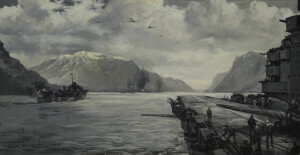 | SHORT DESCRIPTION: Monochrome oil painting on board by British war artist Montague Dawson titled 'The Navy Strikes at the German Battleship Tirpitz in Her Hide-out in the Alten Fjord, in Norway, 1944.' Image in grisaille (a technique utilizing a black and white palette). The image shows planes of the Fleet Air Arm after leaving an aircraft carrier (either HMS Indefatigable, HMS Formidable or HMS Furious) which is depicted at the right. Men are standing on the deck watching the attack. A dazzle painted naval ship steams by to the left of center. Multiple plumes of smoke can be seen rising from the German vessels in the center background. It may show the effects of the attack made on August 24th, 1944, which was the only one to successfully cause damage to the Tirpitz. NOTES: The painting was used as an illustration in the September 23, 1944, pages 400-401. The text supporting the image states: The Navy Strikes at the German Battleship "Tirpitz" in her hide-out in the Alten Fiord, in Norway. The Fleet Air Arm planes leave one of the carriers close to the coast to attack the German vessel with bombs of large and medium size. The "strikes" were carried out over a period of seven days, and four big attacks were made. The vessels engaged approached nearer the Norwegian coast than ever before. In charge of the operations was the C-in-C [Commander in Chief] of the Home Fleet, Admiral Sir Henry R. Moore. Drawing by Montague Dawson. The image supports an article titled 'The Navy's Strike against the "Tirpitz" in Norwegian Waters.' The text of the article reads: On August 22, 23, 24 and 29, aircraft of the Fleet Air Arm, supported by units of the Home Fleet, carried out a series of daring and heavy raids on targets in Norway--and particularly on the German battleship Tirpitz in her hide-out in the Alten Fiord. It was the greatest Fleet Air Arm operation of the war, and in the words of a war correspondent aboard one of the British aircraft-carriers which took part, "may well prove to be the last naval operation of the war in European waters. It was also the Home Fleet's most daring defiance of Hitler's 'fortress'." On the 22nd, the largest number of planes ever to attack Norway took off: they included Barracudas, Corsairs, Hellcats and Seafires. Masthead attacks on the Tirpitz were made, and other targets were also attacked. On the way back, a U-boat was severely damaged. On the 23rd and 24th the attacks were repeated: on the latter day the Germans resorted to a smoke-screen to shield the battleship. The main force on the 29th was again directed at the German battleship. Some of the "strikes" were made so close to the Norwegian coast that men on board the vessels could see with the naked eye the snow on the mountains and the glaciers inland. NOTES: Between August 22 and August 29, 1944, the British Home Fleet, under the command of Admiral Sir Henry R. Moore, and the Fleet Air Arm carried out four carrier-based strikes (called Operation Goodwood) on German u-boats and the Battleship Tirpitz which had sheltered near Kåfjord on the Norwegian coast. The attack fleet was divided into three groups: 1) the battleship HMS Duke of York with the fleet aircraft carriers HMS Indefatigable, Formidable and Furious, two cruisers and fourteen destroyers; 2) the escort carriers HMS Nabob and Trumpeter, cruiser HMS Kent and a group of frigates; and 3) a pair of fleet oilers escorted by four corvettes to support the two attack groups: 22 August 1944 (am) Home Fleet attacked with 44 Barracuda dive bombers/53 fighters, Tirpitz suffered no damage and the Allies lost 3 aircraft. 22 August 1944 (pm) Home Fleet attacked with 14 fighters, Tirpitz suffered no damage and the Allies suffered no losses. 24 August 1944 Home Fleet attacked with 33 Barracuda dive bombers/44 fighters, Tirpitz suffered superficial damage from 2 bomb hits and the Allies lost 6 aircraft. 29 August 1944 Home Fleet attacked with 26 Barracuda dive bombers/41 fighters, Tirpitz suffered no damage and the Allies lost 2 aircraft. NOTES: This was one of eleven paintings in accession 1975.03 that appeared in an exhibition put together by the Christopher Wade Gallery of 28 Bruton Street, London in 1969. The exhibition was opened by the Admiral of the Fleet, Earl Mountbatten of Burma. The title of the exhibition was ‘The Royal Navy at War 1939-1945, An exhibition of Sea Paintings by Montague Dawson, R.S.M.A., F.R.S.A.’ There is a catalog for this exhibition in the Museum’s artist file. The text supporting this painting reads: The Navy's Strike Against the "Tirpitz" in Norwegian Waters. The Navy strikes at the German battleship "Tirpitz" in the hide-out in the Alten Fiord in Norway. The fleet air planes leave one of the carriers to attack the German vessel with bombs of large and medium size. The strikes were carried out over a period of seven days, and four big attacks were made. On August 22nd, 23rd, 24th, and 29th aircraft of the Fleet Air Arm, supported by units of the Home Fleet, carried out a series of daring and heavy raids on targets in Norway-and particularly on the German battleship "Tirpitz"-in her hide-out. It was the greatest Fleet Air Arm operation the war and, in the words of the War Correspondent aboard one of the British aircraft carriers which took part, "may well prove to be the last naval operation of the war in European waters". It was also the Home Fleet's most daring defiance of Hitler's "fortress". | CL11313 | |||||||
| 22 | 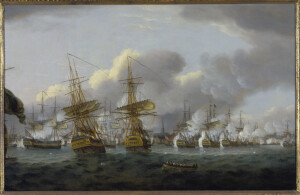 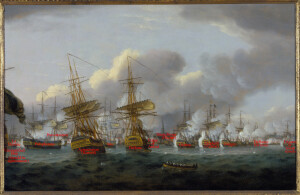 | SHORT DESCRIPTION: Oil painting by Thomas Luny depicting the Battle of Copenhagen (April 2, 1801). The painting seems to depict the action from a position in the outer channel. There are a few technical errors in Luny's positioning of the ships when compared to the sketch of British attack on Copenhagen published in Vol. IV of Sir William Laird Clowes 'The Royal Navy, A History from the Earliest Times to the Present' (Sampson Low, Marston and Company, London, 1899). Moving from left to right: --The starboard end of the stern of an unidentified British ship. Technically, this should be the HMS Agamemnon, which could not weather the Middle Ground against the wind and current and was forced to anchor, but Luny has placed Agamemnon to the left of Bellona instead of the HMS Russell, which was grounded on a spur of the Middle Ground. There is a small rowing boat (numbered 22) with two men at her port quarter. --In the background, one can see the port side and stern of a smaller British vessel. As the vessel is firing its starboard guns, it must be the 40-gun frigate HMS La Désirée, whose orders placed it athwart the bow of the 74-gun ship Provesteenen, which was at the extreme southern end of the Danish line. --A windmill can be seen in the background to Désirée’s right. --Next is a starboard broadside view of the HMS Polyphemus anchored by the stern. When HMS Agamemnon was forced to anchor, Vice Admiral Horatio Nelson ordered Polyphemus to take her place, opposite the Provesteenen. Just beyond Polyphemus’s bow is the stern of a Danish vessel which might be Provesteenen, but as the Danish line of battle is fairly obscured by the English ships its hard to be sure. --Next in the picture is a view of the stern and starboard side of HMS Agamemnon. This is a mistake made by the artist as it was HMS Russell that was grounded near HMS Bellona. The ship is listing to port and men line the yards of the mizzen, main and fore topsails, presumably in the act of furling. A small boat (numbered 13) with several men in it sits at the starboard stern quarter. --Near the bow of Agamemnon is another British vessel, presumably HMS Isis, whose captain, James Walker, positioned his ship between the Danish ships Provesteenen and Wagrien when he realized that Agamemnon would not be able to take up her ordered station. A small boat at her starboard stern quarter is numbered 11. --In the background to the right of Isis is the stern and bow of two more Danish vessels. Behind them you can see buildings and a tall domed tower with a Danish flag flying above it. --The next large vessel is the stern of HMS Bellona, which also grounded on a sand spur extending from the Middle Ground. Men can be seen lining the yard of the main topsail, presumably furling it. A small boat (numbered 12) sits at the starboard stern quarter. --Barely visible to the right side of Bellona is the hull of a British ship, presumably either HMS Edgar or Ardent, and to the right is the stern of a Danish vessel. In the extreme background is a dockyard building and a large church with a tall steeple. In front of the dockyard building is the stern of a Danish vessel that appears to be on fire which would make it the Danish flagship of Commodore Olfert Fischer, Dannebroge, which caught fire from flammable carcass shot fired from HMS Glatton. Carcasses are hollow iron shells filled with a mixture of resin, tallow, turpentine, saltpetre, sulphur and antimony, which produces a fire that is difficult if not impossible to put out in a wooden ship. --To the right of Dannebroge is the HMS Glatton which is anchored by the stern and has smoke billowing from its port side. Its main topsail yard appears broken. In the foreground in front of Glatton is a small ship’s boat being rowed by six men with two officers in the stern. It is seen in a port broadside view. --Next in line is the HMS Elephant, flying Vice Admiral Horatio Lord Nelson’s pendant on the foremast and signal No. 16 (to prepare for Battle when it be necessary to anchor with a Bower or sheet cable in abaft and springs, &c) on the mainmast. It also is anchored by the stern and has smoke billowing from its port side. A small boat sits at the starboard stern quarter. --At Elephant’s bow is HMS Ganges, anchored by the stern. Three more British ships are anchored in front of Ganges with the ship at the end of the line also flying signal No. 16, presumably this is HMS Defiance with Rear Admiral Thomas Graves on board. Near the bow of Defiance is a large Danish flag, the vessel it is flying from is hidden in billowing smoke. Small boats sit at the starboard stern quarter of each of the vessels. --At the extreme right in the background are two small, partially rigged Danish vessels, the northern end of the Danish line of battle and the Trekroner Battery. Behind them are the buildings of the town including a tall square tower. --The sterns of two British vessels can be seen at the right edge. They may be two of the squadron’s frigates or bomb vessels. --The water in the foreground is periodically broken by splashes from cannon shot. NOTES: A nearly identical painting is in the collection of the National Maritime Museum, Greenwich. Item BHC0530. NOTES: Text from The Immortal Memory (catalog published by TMM) which describes the painting: The Copenhagen affair of 2 April 1801 proved a bittersweet victory for Britain which, faced with a loss of vital Baltic markets, found itself forced to attack a traditional ally. Once negotiations had failed, Nelson, leading the bulk of the British force dispatched to reopen the Baltic, sought to annihilate the Danish fleet anchored off the city. The Danes, believing that Nelson would repeat his Nile tactic and strike at the head of their battle line, placed their strongest ships there. But he again demonstrated his unpredictability by sailing past the enemy, only to come back up on the weaker rear of their battle line. The protracted engagement was the most trying of Nelson's career as the British faced both sea- and land-based defenses. Nelson's squadron, seen anchored by the stern alongside their Danish oppponents, included his favorite ship and former command, HMS Agamemnon, 64, visible in the left foreground. The artist Thomas Luny (1759-1837), then a purser in the Royal Navy, painted this view soon after the battle. He detailed knowledge of the ships and tactics employed is reflected in this fine work. | CL29801 | |||||||
| 23 | 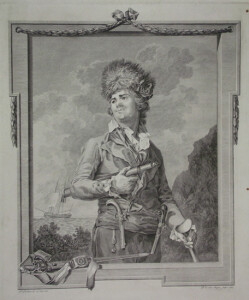 | NOTES: According to the Encyclopedia of Zeeland by the Bibliotheek van Zeeland: Privateer Captain. Pierre le Turcq is the pseudonym of the privateer captain Ghyslain du Plessis. Descended from French parents, he was born in Nantes, but grew up in Vlissingen and was related by marriage to the privateer captain Nicolaas Jarry , through a marriage of his sister to his son. After a career in fishing and smuggling, he enlisted (probably via France) on the American privateer ship of John Paul Jones. Already at the beginning of the Fourth English War (20 December 1780 - 20 May 1784) the merchant fleet of the Republic was so badly damaged that on 12 January 1781 the States-General issued a proclamation regulating the 'free trade'. This business flourished especially in Zeeland and in particular in Vlissingen with shipowners such as Jan Nortier. Le Turq made his name especially with De Vlissinger , a cutter. He lost his first ship, De Jager , a sloop, after only a few days when he captured four small ships off the English coast. In the autumn of 1781 he captured an East Indiaman captured by the English from the French, l'Amitié Royale , manned with 60 sailors and 110 soldiers, while De Vlissinger had only 55 men. True, he lost the ship in a heavy storm, the value of which was estimated at 2 tons of gold, but he returned to Vlissingen with several other prizes. In February 1782, attacked by six enemy frigates, he brought in a brig and sloop Cherbourg, taken at Dover. His popularity increased even more when on 2 March he became involved in a battle with four heavily armed luggers, probably sinking one and forcing the other to retreat, and then capturing several ships. On 7 March, however, he came to blows with an English cutter, had a hard time, but was lucky enough to hit the opponent's boom and ten days later to be welcomed as a hero in Vlissingen; he had also given his shipowners an advantage of more than three tons of gold. On 15 June 1782 he set sail with the brand new privateer brig Zeeuw , but the enemy was now waiting for him; after five days at sea he was attacked near Portland by HMS Defiance and had to surrender. After recovering from serious injuries (his jawbone was completely shattered) he managed to escape from English captivity. It is unclear whether he escaped or was exchanged, the latter is more likely. In September he returned to Vlissingen; although he was promised a new ship, he never set sail again. His voyages are recounted in: Concise description of the notorious crusades of the fearless and famous naval hero Pierre le Turcq with the privateer ship 'De Vlissinger', during the war with the English in the years 1781 and 1782 (Rotterdam 1784). Le Turcq managed to capture a total of nine ships and ration 22. The proceeds are known to have amounted to 169,228 guilders, but the captain probably managed to steal loot worth around 317,000 guilders. NOTES: This is reproduced in Basil Lubbock's "Adventure by Sea from Art of Old Time" (1925), Plate LXXXIX with the following caption: "Pierre le Turc, Capitein op het Vlissingsche Kaper-Schip De Zeeuw." | CL15733 | |||||||
| 24 | 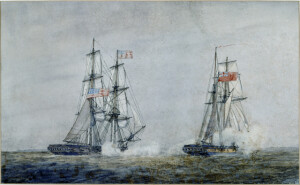 | NOTES: [Excerpt from A Naval History of the American Revolution, Gardner Allen, pages 159-160] Under orders dated October 17, 1776, the Andrew Doria, Captain Isaiah Robinson, sailed for the Dutch island of St. Eustatius for a cargo of military supplies. The ship arrived at the Dutch island on November 16, 1776 and fired a salute of eleven guns which was returned by the fort with two guns less (for a merchant ship). This was considered the first salute offered to the United States. The British complained a the salute was disavowed by the Dutch government and the governor of St. Eustatius was recalled. The Andrew Doria took on stores and sailed for Philadelphia. On the return voyage, near Porto Rico, she captured the British 12-gun sloop of war Racehorse after an engagement of two hours. The Andrew Doria and Racehorse arrived safely in the United States. NOTES: Information concerning the Bailey Collection of watercolor views of U.S. Naval actions (1745-1850) in The Mariners’ Museum, Newport News, Virginia. In 1940 The Mariners’ purchased from a dealer in London a collection of 254 watercolor drawings, which were at the time attributed to Charles T. Warren (1767-1823), an engraver. They were represented as having belonged to a Charles Kingsley Bailey, and have henceforth been referred to as the Bailey Collection. The views in the collection range from the Siege of Louisburg in 1745 to an action which occurred in 1850. Simply on the basis of the breadth of coverage, then, it appeared unlikely that these were executed contemporary to the action by one person. Moreover, persons making studies of individual vessels represented in the collection have pointed out that there are major inaccuracies in the details of the vessels. Research initiated by the museum from 1974 to 1982 subsequently revealed that the watercolors were actually done by Irwin John Bevan (1852-1940). Welsh-born Bevan was a keen naval historian and his sketches and paintings included many maritime subjects. His work can be seen in Sea Fights of the Great War by W.L. Wyllie and M. F. Wrenn, published in 1918. Since Bevan did book illustrations, the present assumption is that this group of watercolors was executed to illustrate a projected work on the history of the U.S. Navy, especially as it related to the British Navy. Detailed contemporary accounts of the U.S.-British actions were written down in letters, official reports and newspapers of the day and nineteenth century historians had these sources available for their texts. The accounts accompanying Bevan’s paintings relied heavily on all these sources. Notwithstanding this however, the paintings must not be taken as primary documents of either the vessels or the engagements. They should be viewed in the context of the artist’s conceptions, which may vary considerably in their reliability. It is left to the discretion of the researcher whether or not this material will be of value in the current project. VESSEL HISTORY: Alternate vessel names: (1) DEFIANCE (?-1775); (2) USS ANDREW DORIA (1775-1777). | CL12733 | |||||||
| 25 | 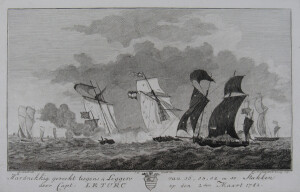 | NOTES: Stubborn fight against 4 Luggers of 16, 14, 12 and 10 Pieces by Capt: Le Turc on the 2nd March 1782. Part of a group of five illustrations of the conquests by Pierre le Turcq in 1782. NOTES: The group of four engravings LE 1749, LE 1750, LE 1751 and LE 1752 may be from: Beknopte beschryving der beruchte kruistogten van den (...) zeeheld, Pierre Le Turcq; met het kaper-schip De Vlissinger, gedurende den oorlog met de Engelschen in de jaaren 1781 en 1782. Rotterdam: Jan de Leeuw, 1784. NOTES: According to the Encyclopedia of Zeeland by the Bibliotheek van Zeeland: Privateer Captain. Pierre le Turcq is the pseudonym of the privateer captain Ghyslain du Plessis. Descended from French parents, he was born in Nantes, but grew up in Vlissingen and was related by marriage to the privateer captain Nicolaas Jarry , through a marriage of his sister to his son. After a career in fishing and smuggling, he enlisted (probably via France) on the American privateer ship of John Paul Jones. Already at the beginning of the Fourth English War (20 December 1780 - 20 May 1784) the merchant fleet of the Republic was so badly damaged that on 12 January 1781 the States-General issued a proclamation regulating the 'free trade'. This business flourished especially in Zeeland and in particular in Vlissingen with shipowners such as Jan Nortier. Le Turq made his name especially with De Vlissinger , a cutter. He lost his first ship, De Jager , a sloop, after only a few days when he captured four small ships off the English coast. In the autumn of 1781 he captured an East Indiaman captured by the English from the French, l'Amitié Royale , manned with 60 sailors and 110 soldiers, while De Vlissinger had only 55 men. True, he lost the ship in a heavy storm, the value of which was estimated at 2 tons of gold, but he returned to Vlissingen with several other prizes. In February 1782, attacked by six enemy frigates, he brought in a brig and sloop Cherbourg, taken at Dover. His popularity increased even more when on 2 March he became involved in a battle with four heavily armed luggers, probably sinking one and forcing the other to retreat, and then capturing several ships. On 7 March, however, he came to blows with an English cutter, had a hard time, but was lucky enough to hit the opponent's boom and ten days later to be welcomed as a hero in Vlissingen; he had also given his shipowners an advantage of more than three tons of gold. On 15 June 1782 he set sail with the brand new privateer brig Zeeuw , but the enemy was now waiting for him; after five days at sea he was attacked near Portland by HMS Defiance and had to surrender. After recovering from serious injuries (his jawbone was completely shattered) he managed to escape from English captivity. It is unclear whether he escaped or was exchanged, the latter is more likely. In September he returned to Vlissingen; although he was promised a new ship, he never set sail again. His voyages are recounted in: Concise description of the notorious crusades of the fearless and famous naval hero Pierre le Turcq with the privateer ship 'De Vlissinger', during the war with the English in the years 1781 and 1782 (Rotterdam 1784). Le Turcq managed to capture a total of nine ships and ration 22. The proceeds are known to have amounted to 169,228 guilders, but the captain probably managed to steal loot worth around 317,000 guilders. | CL16160 | |||||||
| 26 | 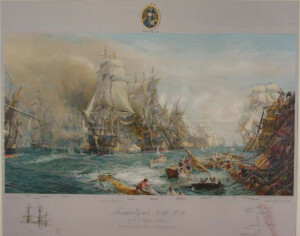 | SHORT DESCRIPTION: Scene during Battle of Trafalgar showing Victory at center. Men in the water, ships destroyed, men in rowboats attempting the rescue of wounded men in water. At the bottom margin are flags in ships rigging signaling "England expects that every man will do his duty." It is signed W.L.W. Oct. 21st. 1905. On the opposite side in the bottom margin is a map of the battle that shows the battle area off the coast of Spain and the locations of wrecked or scuttled ships and the dates of their losses. | CL28974 | |||||||
| 27 | 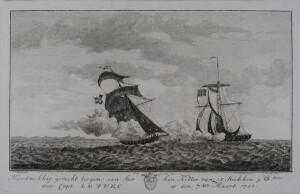 | NOTES: Battle of the privateer captain Pierre le Turcq with the ship Vlissinger against a British cutter of 18 guns, March 7, 1782. Part of a group of five illustrations of the conquests by Pierre le Turcq in 1782. NOTES: The group of four engravings LE 1749, LE 1750, LE 1751 and LE 1752 may be from: Beknopte beschryving der beruchte kruistogten van den (...) zeeheld, Pierre Le Turcq; met het kaper-schip De Vlissinger, gedurende den oorlog met de Engelschen in de jaaren 1781 en 1782. Rotterdam: Jan de Leeuw, 1784. NOTES: According to the Encyclopedia of Zeeland by the Bibliotheek van Zeeland: Privateer Captain. Pierre le Turcq is the pseudonym of the privateer captain Ghyslain du Plessis. Descended from French parents, he was born in Nantes, but grew up in Vlissingen and was related by marriage to the privateer captain Nicolaas Jarry , through a marriage of his sister to his son. After a career in fishing and smuggling, he enlisted (probably via France) on the American privateer ship of John Paul Jones. Already at the beginning of the Fourth English War (20 December 1780 - 20 May 1784) the merchant fleet of the Republic was so badly damaged that on 12 January 1781 the States-General issued a proclamation regulating the 'free trade'. This business flourished especially in Zeeland and in particular in Vlissingen with shipowners such as Jan Nortier. Le Turq made his name especially with De Vlissinger , a cutter. He lost his first ship, De Jager , a sloop, after only a few days when he captured four small ships off the English coast. In the autumn of 1781 he captured an East Indiaman captured by the English from the French, l'Amitié Royale , manned with 60 sailors and 110 soldiers, while De Vlissinger had only 55 men. True, he lost the ship in a heavy storm, the value of which was estimated at 2 tons of gold, but he returned to Vlissingen with several other prizes. In February 1782, attacked by six enemy frigates, he brought in a brig and sloop Cherbourg, taken at Dover. His popularity increased even more when on 2 March he became involved in a battle with four heavily armed luggers, probably sinking one and forcing the other to retreat, and then capturing several ships. On 7 March, however, he came to blows with an English cutter, had a hard time, but was lucky enough to hit the opponent's boom and ten days later to be welcomed as a hero in Vlissingen; he had also given his shipowners an advantage of more than three tons of gold. On 15 June 1782 he set sail with the brand new privateer brig Zeeuw , but the enemy was now waiting for him; after five days at sea he was attacked near Portland by HMS Defiance and had to surrender. After recovering from serious injuries (his jawbone was completely shattered) he managed to escape from English captivity. It is unclear whether he escaped or was exchanged, the latter is more likely. In September he returned to Vlissingen; although he was promised a new ship, he never set sail again. His voyages are recounted in: Concise description of the notorious crusades of the fearless and famous naval hero Pierre le Turcq with the privateer ship 'De Vlissinger', during the war with the English in the years 1781 and 1782 (Rotterdam 1784). Le Turcq managed to capture a total of nine ships and ration 22. The proceeds are known to have amounted to 169,228 guilders, but the captain probably managed to steal loot worth around 317,000 guilders. | CL16159 | |||||||
| 28 | 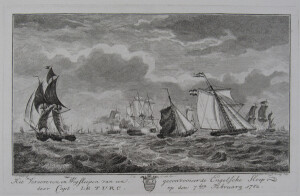 | NOTES: The capture and towing away of an English sloop from a convoy by the privateer captain Pierre le Turcq with the ship Vlissinger, 7 February 1782. Part of a group of five illustrations of the conquests by Pierre le Turcq in 1782. NOTES: The group of four engravings LE 1749, LE 1750, LE 1751 and LE 1752 may be from: Beknopte beschryving der beruchte kruistogten van den (...) zeeheld, Pierre Le Turcq; met het kaper-schip De Vlissinger, gedurende den oorlog met de Engelschen in de jaaren 1781 en 1782. Rotterdam: Jan de Leeuw, 1784. NOTES: According to the Encyclopedia of Zeeland by the Bibliotheek van Zeeland: Privateer Captain. Pierre le Turcq is the pseudonym of the privateer captain Ghyslain du Plessis. Descended from French parents, he was born in Nantes, but grew up in Vlissingen and was related by marriage to the privateer captain Nicolaas Jarry , through a marriage of his sister to his son. After a career in fishing and smuggling, he enlisted (probably via France) on the American privateer ship of John Paul Jones. Already at the beginning of the Fourth English War (20 December 1780 - 20 May 1784) the merchant fleet of the Republic was so badly damaged that on 12 January 1781 the States-General issued a proclamation regulating the 'free trade'. This business flourished especially in Zeeland and in particular in Vlissingen with shipowners such as Jan Nortier. Le Turq made his name especially with De Vlissinger , a cutter. He lost his first ship, De Jager , a sloop, after only a few days when he captured four small ships off the English coast. In the autumn of 1781 he captured an East Indiaman captured by the English from the French, l'Amitié Royale , manned with 60 sailors and 110 soldiers, while De Vlissinger had only 55 men. True, he lost the ship in a heavy storm, the value of which was estimated at 2 tons of gold, but he returned to Vlissingen with several other prizes. In February 1782, attacked by six enemy frigates, he brought in a brig and sloop Cherbourg, taken at Dover. His popularity increased even more when on 2 March he became involved in a battle with four heavily armed luggers, probably sinking one and forcing the other to retreat, and then capturing several ships. On 7 March, however, he came to blows with an English cutter, had a hard time, but was lucky enough to hit the opponent's boom and ten days later to be welcomed as a hero in Vlissingen; he had also given his shipowners an advantage of more than three tons of gold. On 15 June 1782 he set sail with the brand new privateer brig Zeeuw , but the enemy was now waiting for him; after five days at sea he was attacked near Portland by HMS Defiance and had to surrender. After recovering from serious injuries (his jawbone was completely shattered) he managed to escape from English captivity. It is unclear whether he escaped or was exchanged, the latter is more likely. In September he returned to Vlissingen; although he was promised a new ship, he never set sail again. His voyages are recounted in: Concise description of the notorious crusades of the fearless and famous naval hero Pierre le Turcq with the privateer ship 'De Vlissinger', during the war with the English in the years 1781 and 1782 (Rotterdam 1784). Le Turcq managed to capture a total of nine ships and ration 22. The proceeds are known to have amounted to 169,228 guilders, but the captain probably managed to steal loot worth around 317,000 guilders. | CL16161 | |||||||
| 29 | 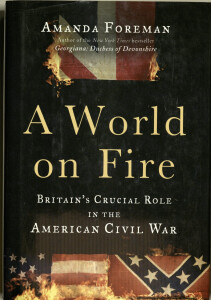 | United States–History–Participation, British. Civil War, 1861-1865; United States–History–Foreign public opinion, British. Civil War, 1861-1865; United States–Foreign relations–Great Britain.; Great Britain–Foreign relations–United States.; United States–Foreign relations–1861-1865.; Great Britain–Foreign relations–1837-1901. | Public opinion–History–19th century. Great Britain | Originally published: London : Allen Lane, 2010. Subtitle varies. | LB107008 | |||||
| 30 | 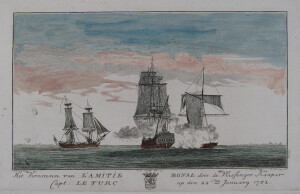 | NOTES: The capture of the French East Indiaman L'Amité Royale from the British by the privateer captain Pierre le Turcq with the ship Vlissinger, 24 January 1782. Part of a group of five illustrations of the conquests by Pierre le Turcq in 1782. NOTES: The group of four engravings LE 1749, LE 1750, LE 1751 and LE 1752 may be from: Beknopte beschryving der beruchte kruistogten van den (...) zeeheld, Pierre Le Turcq; met het kaper-schip De Vlissinger, gedurende den oorlog met de Engelschen in de jaaren 1781 en 1782. Rotterdam: Jan de Leeuw, 1784. NOTES: According to the Encyclopedia of Zeeland by the Bibliotheek van Zeeland: Privateer Captain. Pierre le Turcq is the pseudonym of the privateer captain Ghyslain du Plessis. Descended from French parents, he was born in Nantes, but grew up in Vlissingen and was related by marriage to the privateer captain Nicolaas Jarry, through a marriage of his sister to his son. After a career in fishing and smuggling, he enlisted (probably via France) on the American privateer ship of John Paul Jones. Already at the beginning of the Fourth English War (20 December 1780 - 20 May 1784) the merchant fleet of the Republic was so badly damaged that on 12 January 1781 the States-General issued a proclamation regulating the 'free trade'. This business flourished especially in Zeeland and in particular in Vlissingen with shipowners such as Jan Nortier. Le Turq made his name especially with De Vlissinger, a cutter. He lost his first ship, De Jager, a sloop, after only a few days when he captured four small ships off the English coast. In the autumn of 1781 he captured an East Indiaman captured by the English from the French, l'Amitié Royale, manned with 60 sailors and 110 soldiers, while De Vlissinger had only 55 men. True, he lost the ship in a heavy storm, the value of which was estimated at 2 tons of gold, but he returned to Vlissingen with several other prizes. In February 1782, attacked by six enemy frigates, he brought in a brig and sloop Cherbourg, taken at Dover. His popularity increased even more when on 2 March he became involved in a battle with four heavily armed luggers, probably sinking one and forcing the other to retreat, and then capturing several ships. On 7 March, however, he came to blows with an English cutter, had a hard time, but was lucky enough to hit the opponent's boom and ten days later to be welcomed as a hero in Vlissingen; he had also given his shipowners an advantage of more than three tons of gold. On 15 June 1782 he set sail with the brand new privateer brig Zeeuw , but the enemy was now waiting for him; after five days at sea he was attacked near Portland by HMS Defiance and had to surrender. After recovering from serious injuries (his jawbone was completely shattered) he managed to escape from English captivity. It is unclear whether he escaped or was exchanged, the latter is more likely. In September he returned to Vlissingen; although he was promised a new ship, he never set sail again. His voyages are recounted in: Concise description of the notorious crusades of the fearless and famous naval hero Pierre le Turcq with the privateer ship 'De Vlissinger', during the war with the English in the years 1781 and 1782 (Rotterdam 1784). Le Turcq managed to capture a total of nine ships and ration 22. The proceeds are known to have amounted to 169,228 guilders, but the captain probably managed to steal loot worth around 317,000 guilders. | CL16162 | |||||||
| 31 |  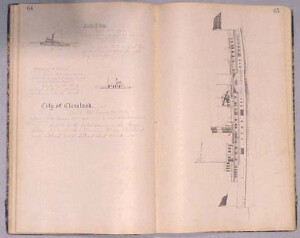 | NOTES: See object file for a detailed remarks and condition report of the individual book pages and illustrations. The book also includes an illustrated copy of the poem "The Ancient Mariner". NOTES: This sketchbook of Samuel Ward Stanton includes the following sketches and descriptions of vessels: p. 7 A.B. VALENTINE p. 8 ANGLER & AMERICA p. 9 ALABAMA & ALIDA p. 10 ALBANY p. 11 ALBANY, A.C. NICKERSON, AMERICA, ALFRED & EDWIN p. 12 ANSONIA, ARCHIE CORSMAN, ALERT, ARROW, ATLAS p. 13 AMOS C. BARSTOW, ANN JANE, LAUGLIN, A.C. CHENEY, ANNIE LAURIE & ALBERTINA p. 14 ALICE, ADMIRAL, A.R. GRAY, ALBERTA M., ALICE E. CREW, ASTORIA & ACADIA p. 15 ALBANY, ACTIVE, ADMIRAL, FARRAGUT, ATHLETE, A.J. HOOLE p. 16 ACCOMAC, AMERICAN EAGLE, ARMITABE BREARLY, ATLANTA 7 ALICE HEGARTY p. 17 AMERICA, AROMA MILLS, ARTISAN & ARIOSA p. 18 ANNEX, A.C. ROSE, ANNIE & MAGGIE, ANNA J. KIPP, AMBOY & A.C. SUMNER p. 19 AUSTIN, ATLANTIC, AMELIA, ANNEX Z p. 20 ANNA, ALICA A. WASHBURN p. 21 ADELAIDE, ABBIE, AMITE p. 22 ANNEX 3, ASSISTANCE, ATRATO & ARIES p. 23 AMERICA, AERONAUT, ALASKA, ARIZONA p. 24 BAY RIDGE, BRILLIANT & BAY RIDGE p. 25 BALTIMORE, BAY STATE p. 26 BATTLER, BURLINGTON, BOY, BORDER CITY, B.W. MORSE p. 27 BAY QUEEN AKA GENL. SEDGWICK p. 28 BELLE, BROOKLYN, BLUE STONE COMPANY & BALTIC p. 29 BRIDGEPORT, BEN, BLANCHE PAIGE & BRANDON p. 30 BELLEVUE & BALTIMORE p. 31 BLACK BIRD, BUFFALO, BLUE BONNET, BORDENTOWN p. 34 BEE, BELLE HORTON p. 35 BAYONNE, BS CRONIN, BLOCK ISLAND, BLUE STONE p. 36 BELT, BERGEN POINT, BELLE & HATTIE p. 37 CASTLETON, CYCLOPS, CEMENT ROCK, CORNELIUS VAN COTT' p. 38 CHESTER A. ARTHUR, CLIMAX, CITY OF YONKERS, CORNELIA p. 39 CITY OF TROY p. 40 CITY OF BRIDGETON, COLDEN, COL. E. B. GRUBB, C.H. STARBUCK, C.A. DICKEY p. 41 CANONIEUS, CHAUCEY M. DEPEW, CRYSTAL STREAM, C.L. MARCHAL p. 42 CONNECTICUT, CHAS. H. SENIFF p. 43 C. VANDERBILT p. 44 CHRYSTENAH, COMMONWEALTH, CLARA, CHAS. A. SILLIMAN p. 45 CETUS, COM. DURYEA, CYRENE p. 46 CHARLOTTE, VANDERBILT, CLARA, CHIEF, CLINTON p. 47 CITY POINT, COLORADO, CHARLES RUNYON p. 48 CITY OF LAWRENCE, CITY OF WORCESTER P. 49 CHAUNCEY VIBBARD, COMMUNIPAW, CITY OF MONTICELLO p. 50 CITY OF SPRINGFIELD, CHARLES C. COUTANT p. 51 CRYSTAL WAVE, CHAS. E. SOPER, CAROLINE A. PEENE, CHICAGO p. 52 CITY OF RICHMOND p. 53 CITY OF RINGSTON, COE F. YOUNG AND CHRISTIANA p. 54 CITY OF SPRINGFIELD p. 55 CAYUGA, CITY OF NORWALK, CAPTAIN JOHNM, CHAS ALLEN p. 56 COLUMBIA p. 57 CEPHEUS, CITY OF ALBANY p. 58 CONTINENTAL p. 59 CITY OF NORWICH, C.W. STANDART, CITY OF BRIDGEPORT p. 60 CHANCELLOR p. 61 CITY OF LONG BRANCH, CORA L. STAPLES, COM. BARNEY p. 62 CITY OF HUDSON, CLAR, C.F. ROE, CLAVIN TOMKINS p. 63 CHAMPION, CLARA, CATSKILL p. 64 CHARLES R. STONE, CHARLES F. STARIN p. 65 CITY OF CLEVELAND p. 66 COMMUMPAW, CAPE CHARLES p. 67 CITY OF BOSTON, CITY OF NEW YORK p. 68 CAMELIA, CERES, CONQUEROR p. 69 CITY OF FALL RIVER, CHAS. B. SANDORD p. 70 COMMODORE PERRY, CITY OF BROCTON p. 71 CYGNUS, CRESCENT CITY p. 73 C.H. NORTHAM p. 75 COLUMBIA p. 76 CADET, CLARION p. 77 CITY OF DETROIT p. 78 COMMONWEALTH p. 81 D.S. MILLLER, DEFIANCE, DOUGLAS, DIAMOND p. 82 DAKOTA, DELAWARE (Built 1883, South Amboy, New Jersey, Belonged to Pennsylvania Rail Road) p. 83 AUGUSTA, AGAWAM, ARIEL COOLEY, ATLANTA, ADVOCATE, ARROW, AMERICAN EAGLE, ALBANY p. 84 ARABIAN, AUGUSTA, AMITY, ALGONQUIN, ARIEL, AVALANCHE, ASIA, ALBANY, ALABAMA, AMBOY, AUGUSTA, ANSON p.107 STR. PERSEUS p.109 MARTHA WASHINGTON p.112 STR. CONNECTICUT p.116 STR. NEW YORK p.166 MUTUAL p.177 VIVA, E.T. DUBLOIS, IDA L. TEBO p.203 BLACK BIRD p.213-216 Poem "The Monitor" published in Harper's Weekly, May 9, 1863 with pen/ink sketch of MONITOR sinking. p.219 YOSEMITE p.223 SCANDINAVIAN p.239 L.A. BELKNAP p.267 CONNECTICUT, MAINE, CITY OF W p.269 LYNN p.271 E.P. PICKETT p.277 FRED B. Dalzell p.279 WM F. BURDEN, ECLIPSE, CONTINENTAL, OLLIE p.280 PEGUOT | CL23609 | |||||||
| 32 | 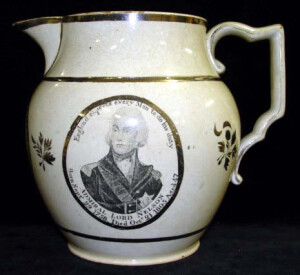 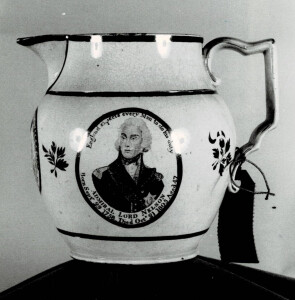 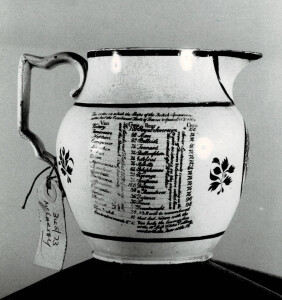 | SHORT DESCRIPTION: Printed with a portrait of Lord Nelson. Inscribed above the black transfer of Nelson, 'England expects every man to do his duty'. Reverse: Line of Battle for Trafalgar. The order in which the ships of the British squadron attacked the combined Fleet of France and Spain, October 21, 1805. Under the lip of the jug a figure of Britannia. Inscribed above, 'Britannia' below, 'May peace upon the Nation smile, and plenty bless the British Isles'. Under the Nelson transfer, 'Admiral Lord Nelson, Born September 29, 1758, died Oct. 21st 1805, aged 47.' All within silver luster boarders. | CL4905 | |||||||
| 33 | 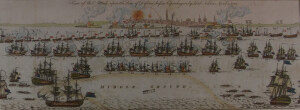 | SHORT DESCRIPTION: Hand colored view titled 'View of the Attack upon the Line of Defence, before Copenhagen, by Lord Nelson, April 2, 1801' at the top. The image shows a panorama of Lord Nelson's attack looking from the Middle Ground towards the city of Copenhagen. The Middle Ground sits at the bottom center with seven English bomb vessels anchored along its edge. Three of the vessels are in the process of lobbing bombs into the harbor and town of Copenhagen. To the left of the Middle Ground are the anchored Agamemnon, the Bellona and Russel aground, the brigs Harpy and Cruiser and several small rowing boats full of men. At the lower right is a ship of the reserve squadron and seven small rowing boats full of men. At the center of the image is a line of fourteen British warships, ten are anchored with their starboard side facing the viewer and the other four appear to be sailing towards the action with their port sides to the viewer. Beyond the British line is a line of twenty-four Danish vessels of various size (most with no masts). At the left end of the Danish line the 40 gun ship Desiree is in action with a Danish ship of the line (with no masts). Just in front of the Danish line at the right are the Crown batteries, both of which appear to be firing upon the British ships. In the background at the left is the lunette quintus, firing towards the action. To its right is the arsenal of Copenhagen, which has smoke and flames rising from its left end. To the right of the arsenal is the large citadel of Copenhagen. Smoke rises above it. Beyond the fortifications the town with many church steeples can be seen. To the right and left of the town is the green countryside with windmills. NOTES: [J. Willoz-Egnor, 4/18/2024] This is the middle section of 'Fairburn's Plan of Parker and Nelson's Victory before Copenhagen, April 2nd, 1801.' Published by John Fairburn April 22, 1801. The sections cut away show a map titled 'Passage of the Sound to Copenhagen & Draco. exhibiting the track of the British Fleet' at the top and text providing references for the view of the battle and a discussion of the action. The text at the bottom has been provided below. A full copy of the broadside is in the collection of The British Museum (accession number 1853,0212.239). The references to the numbers and letters on the engraving is as follows: British Line: 1 Polyphemus (64 guns), 2 Isis (50 guns), 3 Edgar (74 guns), 4 Ardent (64 guns), 5 Glatton (54 guns), 6 Elephant (74 guns), 7 Ganges (74 guns), 8 Monarch (74 guns), 9 Defiance (74 guns), 10 Amazon (38 guns), 11 Blanche (36 guns), 12 Alemene (32 guns), 13 Dart (30 guns), 14 Arrow (30 guns), 15 Otter (fire-ship) (14 guns), 16 Zephyr (fire-ship) (14 guns), 17 Desiree (40 guns), 18 Bellona (shown run aground) (74 guns), 19 Russel (shown run aground) (74 guns), 20 Agamemnon (shown at anchor) (64 guns), 21 Harpy (brig) (18 guns), 22 Cruiser (brig) (18 guns), 23 to 29 are the bomb vessels Discovery (16 guns), Sulphur (10 guns), Hecla (10 guns), Explosion (8 guns), Zebra (16 guns), Terror (8 guns), and Volcana (8 guns). Letter A is Sir Hyde Parker's squadron in reserve, Letter B are the Boats, ready to give assistance. Danish Line: 1 Ship of the line, 2 Ship of the line, 3 a frigate battery, 4 a frigate battery, 5 Ship of the line, 6 floating battery, 7 floating battery, 8 floating battery, 9 Ship of the line, 10 frigate battery, 11 frigate battery, 12 frigate battery, 13 Ship of the line, 14 floating battery, 15 floating battery, 16 Ship of the line, 17 frigate battery, 18 bomb vessel, 19 Ship of the line, 20 Ship of the line, 21 gun vessel, 22 gun vessel, 23 Ship of the line, 24 Ship of the line. Letters C are the Crown Islands and batteries, mounting 88 guns. D is the Citadel of Copenhagen. E is the Arsenal. F is the Lunette Quintus. The text supporting the plan is as follows: This most brilliant and unexampled Victory was achieved by that invincible Son of Neptune and Colossus of the Ocean, LORD NELSON, and the brave Officers and Men under his Command, before Copenhagen, which ended in the total Defeat of the Danish Line, Seventeen of which was Taken, Burnt, and Sunk. The British Ships, (except the 3 most damaged,) were reported ready for Sea, in less than 24 Hours after the Action. From the LONDON GAZETTE EXTRAORDINARY, April 15, 1801. ADMIRALTY-OFFICE, April 15, CAPTAIN OTWAY, of His Majesty's Ship the London, arrived this Morning with the following Dispatches from Admiral Sir Hyde Parker, Commander-in-Chief, dated on board the London, in Copenhagen Roads, the 6th Instant: SIR, ON the 30th of last Month, the Wind having come to the Northward, we passed into the sound with the Fleet, but not before I assured myself of the hostile intentions of the Danes to oppose our Passage. After anchoring about Five or Six Miles from the Island of Huin, I reconnoitered, with Vice-Admiral Lord Nelson and Rear-Admiral Graves, the formidable Line of Ships, Radeaus, Pontoons, Galleys, Fire-Ships, and Gun-Boats, flanked and supported by extensive batteries on the two islands called the Crowns; the largest of which was mounted with from fifty to seventy pieces of cannon; these were again commanded by two ships of seventy guns, and a large frigate in the Inner Road of Copenhagen; and two sixty-four gun Ships (without Masts) were moored on the Flat, on the starboard side of the entrance into the Arsenal. The day after, the wind being southerly, we again examined their position, and came to the resolution of attacking them from the Southward. Vice-Admiral Lord Nelson, having offered his services for conducting the attack, had, some days before we entered the Sound, shifted his flag to the Elephant; and after having examined and buoyed the Outer Channel of the Middle Ground, his Lordship proceeded with the twelve ships of the Line named in the reference, all the frigates, bombs, fire-ships, and all the small vessels, and that evening anchored off Draco Point to make his disposition for the attack, and wait for the wind to the southward. It was agreed between us, that the remaining ships with me should weigh at the same moment his Lordship did, and menace the Crown Batteries, and the four ships of the line that lay at the entrance of the arsenal; as also to cover our disabled ships as they came out of action. I have now the honour to enclose a copy of Vice-Admiral Lord Nelson's report to me of the action on the 2nd instant. His Lordship has stated so fully the whole of his proceedings on that day, as only to leave me the opportunity to testify my entire acquiescence and testimony of the bravery and intrepidity with which the action was supported throughout the line. Was it possible for me to add any thing to the well-earned renown of Lord Nelson, it would be by asserting, that his exertions, great as they have heretofore been, never were carried to a higher pitch of zeal for his Country's service. I have only to lament that the sort of attack, confined within an intricate and narrow passage, excluded the ships particularly under my command from the opportunity of exhibiting their valour; but I can, with great truth assert, that the same spirit and zeal animated the whole of the fleet I have the honour to be, &c H. PARKER. Elephant, off Copenhagen, 3d April, 1801. SIR, IN Obedience to your directions to report the proceedings of the squadron which you did me the honor to place under my Command, I beg leave to inform you that having buoyed the Channel of the Outer Deep, and the Position of the Middle Ground, the squadron passed in safety, and anchored off Draco the evening of the first; and that yesterday morning I made the signal for the squadron to weigh, and to engage the Danish line, consisting of six sail of the line, eleven floating batteries, mounting from twenty-six 24 pounders to eighteen 18 pounders, and one bomb-ship, besides schooner gun-vessels. These were supported by the Crown Islands mounting eighty-eight cannon, and four sail of the line moored in the Harbour's mouth, and some batteries on the island of Amak. The bomb-ship and schooner gun-vessels made their escape, the other seventeen sail are sunk, burnt, or taken, being the whole of the Danish line to the southward of the Crown Islands, after a battle of four hours. From the very intricate navigation, the Bellona and Russel unfortunately grounded, but although not in the situation assigned them, yet so placed as to be of great service. The Agamemnon could not weather the shoal of the Middle, and was obliged to anchor; but not the smallest blame can be attached to Captain Fancourt; it was an event to which all the ships were liable. These accidents prevented the extension of our line by the three ships before-mentioned, who would, I am confident, have silenced the Crown Islands, the two outer ships in the harbour's mouth, and prevented the heavy loss in the Defiance and Monarch, and which unhappily threw the gallant and good Captain Riou (to whom I had given the command of the frigates and sloops named in the margin, to assist in the attack of the ships at the harbour's mouth) under a very heavy fire; the consequence has been the death of Captain Riou, and many brave officers and men in the frigates and sloops. The bombs were directed and took their stations abreast of the Elephant, and threw some shells into the arsenal. The boats of those ships of the fleet, who were not ordered on the attack, afforded us every assistance; and the officers and men who were in them merit my warmest approbation. The Desirée took her station in raking the Southernmost Danish ship of the line, and performed the greatest service. I have the Honour to be, &c. &c. &c. NELSON and BRONTE. A list of the killed and wounded followed. At the close of this important victory, the DANISH GOVERNMENT and LORD NELSON agreed to a cessation of arms:- And on the 9th of April an armistice was signed, and concluded, between Admiral Sir Hyde Parker, Commander-in-Chief, and the Court of Denmark, by which it was agreed that no act of hostility should be committed by either party, on the coast of the islands and provinces of Denmark and Jutland, for fourteen weeks from the above date; and, after the expiration of that time, each party may declare its termination, and recommence hostilities, after giving a previous notice of fourteen days: -And also, the Court of Denmark has agreed to suspend, during that period, her active co-operation under the Treaty of the Armed Neutrality. | CL27141 | |||||||
| 34 | 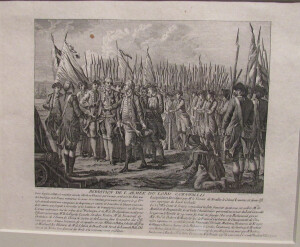 | NOTES: [J. Willoz-Egnor, 3/19/2025] The Library of Congress publication 'The American Revolution in drawings and prints; a checklist of 1765-1790 graphics in the Library of Congress' describes a version of this print (#324): Print of the surrender of the army of Lord Cornwallis possibly portrays Rochambeau motioning to Cornwallis' deputy, Gen. Charles O'Hara of the Guards, to present his sword to the American Commander in Chief. The narrative below this picture provides a summary of particulars regarding the seige of Yorktown, including lists of arms and equipment rendered, participating French and American officers, and officers who distinguished themselves as well as those killed or wounded. On another version of the image (#325) its is stated: Gen. Charles O'Hara, commander of the 2d Battalion of Guards, represented Cornwallis in the surrender at Yorktown. In a final gesture of British defiance toward the Americans, O'Hara first offered his sword to Rochambeau, but the French officer quickly directed him to General Washington. Maj. Gen. Benjamin Lincoln actually received the weapon. The entry for #324 states there are several different impressions of this image in the Library of Congress collections: one from Ponce, Nicholas and Godefroy, Francois. 'Recueil d’estampes représentant les différents événemens de la Guerre qui a procuré l’Indépendance aux Etats unis de l’Amérique' [Collection of engraved plates representing various events in the war that brought independence to the United States of America]. Paris: Ponce & Godefroy, [circa 1784]. Ours does not appear to be from this publication as it has a different artist and engraver identified under the image. The other impressions in the LoC include two earlier states and a wash drawing and 'another impression'. I have not found any other impression that matches the artist and engraver listed on our print. NOTES: Rough translation of text at bottom of engraving: 8000 English soldiers and sailors, invested at York in Virginia by the combined army of the United States of America and France, laid down their arms and surrendered as prisoners of war on 19 August 1781. Abandoning to the victors 22 flags, 170 cannons and 8 mortars, the Charon, a 50-gun ship, a frigate, 2 corvettes and 60 transport ships were taken or destroyed. The victorious army under the command of General Washington and Mr. de Rochambeau had as General Officers Msr. De la Fayette, Lincoln, Struben, Veiden, Msr. de Viomesnil, de Chatelux de S. Simon de Choisy de Custine, and de Lauzun, among the officers who found the opportunity to distinguish themselves, we cite Mr. Robert Dillon, Scheldon, Beffroy, and Monthurel. The wounds of Msr. De S. Simon, Deux Ponts, Sireval, Lameth, Billi, Dillon, and du Tertre give them the right to public recognition. (bottom left column), The Capitulation was drawn up by Mr. Viscount de Noailles, Colonel Laurens, and two senior officers of Lord Cornwallis. On the 5th of July, Mr. Count de Grasse, commanding the French fleet, having under his command Msr. De. Monteil and de Bougainville, had beaten Admiral Graves who came to the aid of Lord Cornwallis. The ship Le Terrible of 74 guns, was burned, the frigates Iris and Richemond taken. Msr. Le Maris de Chabert de Montecler the C. de Framond, Captains, de Champmartin de Gouzillon Second Captains, Goyon de Vauroault, l'Hermitte, Maillanne, Destourres, de Krieger, de Hauguen Houzen, Anvray de la Balaiziere, le Cordier, Lieutenants, de Sambucy de Brochere, vil and Dalmas, were wounded while supporting the honor of the French flag, as well as Msr. Bertrix, Taschereau and Bardin Land Officers. We regret Msr. De Boades Captain of ship, d'Orvault, Rhaab, and Villeon, iyer (?) (bottom right column); | CL17016 | |||||||
| 35 | No image URL. | Great Britain–History, Naval–19th century.; France–History, Naval–19th century.; Spain–History, Naval–19th century. | Trafalgar, Battle of, 1805.; Ships of the line–History–19th century–Great Britain; Ships of the line–History–19th century–France; Ships of the line–History–19th century–Spain | The ships of Trafalgar : __the British, French and Spanish fleets, October 1805 __Peter Goodwin | LB92196 | |||||
| 36 | 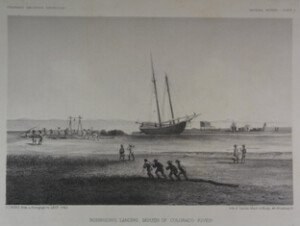 | SHORT DESCRIPTION: Black and white lithograph titled 'Robinson's Landing, Mouth of Colorado River. ' NOTES: Published on page 26 of 'Report upon the Colorado River of the West, Explored in 1857 and 1858 by Lieutenant Joseph C. Ives...', published by the Government Printing Office in Washington D.C. Notes from the text describing the plate (pages 27-: November 30--after reaching the northeast end of Montague island, a white speck came in sight towards the northwest, which Captain Walsh told me was the house at "Robinson's Landing," near which is the usual anchorage for vessels coming to the mouth of the river...Mr. Carroll and myself went ashore in a boat, and walked up to the house--a small frame building resting on the tops of piles about four feet above the ground...The whole of the country near the west bank of the river is low and overflowed at the highest tides. Robinson's landing is the most elevated point, and even this, Captain Walsh tells me, is often submerged...Along the shore the face of the bank is very steep, and it is difficult to see how the boilers and the heavy parts of the steamboat are to be landed. During the spring tides, which are now at hand, the water runs out so rapidly that for only a few moments would the deck of the schooner be above the level of the surface of the ground and near enough to it to discharge freight, and the hands would have to be constantly employed in booming her off, or the hull might catch upon the face of the bluff and the vessel be capsized as the water fell. The government stores are always transferred directly from the deck to the steamboats. The latter were built at a point several miles higher up, at a locality better suited for such an undertaking, but Captain Walsh is not at liberty to run the risk of ascending the river with his schooner any further. By the side of Robinson's house, at the head of the gully previously mentioned, is an excellent position for a vessel to lie, and to which she could easily be floated during the high water that may be expected in the course of the next two days; but as the landing of the property will occupy some time, it would be necessary that she should remain high and dry till the next spring tides came to float her off... December 1--This morning Captain Walsh made a careful examination to find a place where it would be possible to land the steamboat material and other stores, but the bank at every point was found to be too shelving to admit of the discharge of freight from the deck of the schooner, excepting at high tide, and then the rapid fall of the water and the swift current would render the operation difficult if not impracticable. The gully near the house was again inspected. Near its head the sides are curved and the width and depth are just about sufficient to admit the hull of the Monterey, and bring the deck a proper distance above the level of the surrounding surface. At low water and during the neap tides of the coming fortnight she would have to lie, high and dry, fifteen or twenty feet above the river; a position so new for a shipmaster to place his vessel in that it was with great reluctance that Captain Walsh yielded to the necessity of the case and determined, at high water in the evening, to float his schooner in. At this season the flood during the day is by no means so great or violent as at night, and is unaccompanied by the [tidal] "bore." The surface at high water was five feet lower than it was last night, and it was impossible to take the schooner to the desired position. She was accordingly anchored near the shore, in the most sheltered place that could be found, and tonight the attempt will again be made to haul her into the gully, and as it will be the tide following the full of the moon, there will probably be water enough to accomplish our object. Owing to our sheltered position the flow of the ebb about the vessel this evening has been quite moderate. December 2.--The flood came in last night with a violence even greater than that of that preceding. The Monterey, though moored in a place comparatively unexposed, dragged her anchors and was carried a mile up the river; but as high water approached lines were taken out, the necessary preparations made, and, by great exertions on the part of the men, she was floated into position at the head of the gully. This morning, after the water had fallen, she lay snugly encased between the grassy banks, twenty feet above the surface of the river, secure from the effects of tides and storms, but presenting a very odd appearance, and inspiring Captain Walsh with apprehensions lest there should never be another tide that would rise high enough to float her out. The whole surface of the country was overflowed last night, and the soil, being almost entirely clay, presents an unbroken sheet of soft and tenacious mud, into which one sinks deeply at every step. The day has been spent in landing the boiler and heavy portions of the steamboat, and it proved a task of no small difficulty to move these unwieldy masses through the saturated surface. As the new moon tides at this season are not so high as those of the full moon, it is not probable that the bank will be again overflowed for a month, and a week's exposure to the warm sun will improve its condition, but a more unpromising place to build a steamboat in could scarcely be imagined. There is no growth of any description. Scattered about in the mud, one or two miles distant, are logs of half decayed driftwood, and from these we have to select the material for building the ways and derricks and to furnish fuel for the camp fires. Some of the men have already commenced this work, and with two or three harnessed to a log and sinking knee deep at almost every step, each stick is hauled through a mile and a half of gulleys and mud into camp. December 4. During the last two days the vessel has been unloaded and all of the expedition property discharged. Many things had been injured by salt water getting into the hold, but the essential parts of the steamboat, engine, and the provisions are safe. The unloading being completed, Captain Walsh kindly gave me permission to engage his crew to assist my own small force, for a few days, while accomplishing the heavy labor attending our first operations, and the arduous task of bringing a sufficient quantity of logs is almost completed. The drying of the soil proceeds very slowly, but as the bank has not been again overflowed the tents have been pitched, the provisions and stores securely stowed, and camp fairly established. A spot has been trenched and platformed and prepared with a suitable foundation for a temporary observatory; the observing tent erected and a transit placed approximately in position. Regular astronomical and meteorological observations will henceforward be made and a record kept of the tides, gauges having been put up for that purpose. The tides are now rapidly subsiding and the water runs with greatly diminished velocity. The days continue warm and delightful, though at night the temperature is low, and a chill wind sometimes sweeps over the wet flats, making the air disagreeable and raw. The atmospheric changes impart variety to a scene that would otherwise be oppressively monotonous. December 7.--This morning the excavation of the pit was completed, and from the pilė of drift logs that the men had brought in some fifteen or twenty of the straightest and soundest were selected, and a row of posts sunk into the ground, about seven feet apart, along either side of the bottom. Each post is to be united to the opposite one by a cross log fitted upon the tops, making a kind of trestle, of which there will be half a dozen placed parallel to one another, and fastened together by cross and longitudinal braces. The upper surfaces are then to be squared off to a general level, and a rude substitute thus formed for ways, but one which we hope will well enough answer the purpose. While the carpenter was employed in fitting this rough frame work the other hands undertook the task of moving the boiler up to the side of the pit. It weighs three tons, and though the distance was only twenty-five or thirty yards, there being no convenient moving appliances, it took ten men nearly the whole day to work it along through the deep mud into its place. The steamboat was built to order in Philadelphia at very short notice, and was put together and tried upon the Delaware river before being taken to pieces for shipment. NOTES: From 1857 to 1858 Ives commanded an expedition to explore up the Colorado River from its mouth. He designed, built and tested his own stern-wheel steamboat, then shipped it to the Colorado River Delta. At Robinson's Landing he reassembled then used the 54-foot steamboat Explorer to map and survey the river. His party included Smithsonian associate John Strong Newberry as geologist. He led his party up the Colorado to the lower end of the Grand Canyon, then struck out across the desert to Fort Defiance in Colorado. Ives reported his findings in his 1861 'Report upon the Colorado river of the West.' The Ives expedition produced one of the important early maps of the Grand Canyon drawn by Frederick W. von Egloffstein, topographer to the expedition. Robinson's Landing was located in Baja California, Mexico, on the west bank of the Colorado River northwest of the north tip of Montague Island in the Colorado River Delta. It was 10 miles above the mouth of the river on the Gulf of California. | CL17223 | |||||||
| 37 | 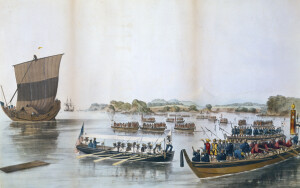 | SHORT DESCRIPTION: Colored lithograph titled "Passing the Rubicon." Taken from a folio titled "Illustrations of the Japan Expedition." Produced and ublished in 1855 by Eliphalet M. Brown, Jr., and printed by the lithographic printer of Sarony & Co, New York. The lithograph reproduces a drawing by Wilhelm Heine. The print shows a small American boat commanded by Lt. Silas Bent confronted by Japanese boats (guard boats are probably oshiokuribune) while surveying Edo Bay. USS Mississippi is in the background standing watch over the survey boat as well as a large Japanese boat watch over the scene. Mount Fuji is in the background. NOTES: Perry's squadron of four ships arrived at Yedo Bay on July 7, 1853 and anchored off the city of Uraga. On this first visit to Japan, Perry's primary mission was to deliver the President's letter to the Emperor of Japan. While negotiating the conditions under which the letter would be delivered, Commodore Perry dispatched boats to survey the harbor. At this time the squadron sat at anchor off Uraga and outside a point the Americans called "Point Rubicon." To the Japanese "Point Rubicon" marked the outside edge of what was know as the Cape Kannon-Futtsu line. That geographical area was considered of major military defensive importance to the Japanese and Perry understood that. It marked a militarily important narrow point in the Uraga channel in Yedo Bay. In "Passing the Rubicon" with survey boats, the American squadron was making an uninvited entry into a highly restricted and protected area. The danger of this situation was clearly recognized by Perry and while he was probing for the Japanese response, he did so with a small force intended to demonstrate no hostile intent. As anticipated, Lt. Bent's survey party was confronted by Japanese guard boats. Weapons were drawn by both the American and Japanese forces. While the Japanese guard boats did not interfere with the survey, this was the first armed military confrontation faced by Perry in Japan. This lithograph depicts the confrontation on July 11, 1853, between an American survey boat under the command of Silas Bent and Japanese guard boats. The narrative states: A boat had been sent at daylight from each ship of the squadron to survey the bay and harbor of Uraga. The governor, on observing these boats, inquired what they were doing, and when he was told that they were surveying the harbor, he said it was against Japanese laws to allow of such examinations; to which he received for reply, that the American laws command them, and that Americans were as much bound to obey the American as he was the Japanese laws. The surveying boats, which seemed to give so much uneasiness to the governor, had been well manned and armed, and Lieutenant Bent, of the Mississippi, who was in command, was instructed not to go beyond the range of the ship's guns, while a good look-out was kept upon the surveying party, in order that assistance might be sent to them should they be attacked. In addition to the usual boat ensigns at the stern, white flags, indicative of their peaceful intentions, were borne on the bows. They spread themselves out toward the opposite shore as they pulled away, sounding at every boat's length, and had reached about two miles further up the bay than the anchorage of the squadron, when they were recalled by a signal gun. On their return they were sent out again, with orders to keep nearer to the western shore. In the afternoon all the boats returned, coming alongside at about three o'clock pm. On the first approach of the survey boats the soldiers showed themselves in considerable force, and were observed to be fully armed. They presented quite a bristling front with their spears and match-locks, while their lacquered caps and shields flashed brightly in the sun. They did not seem disposed, however, to make a very decided stand, for they retreated within the walls of the fortifications as soon as the boats made in closer with the land. One of the officers in command of a ship's boat approached to within a hundred yards of the shore, and observing three persons seemingly of authority, standing out upon an embankment, levelled his glass at them, whereat they disappeared on the instant, evidently much discomposed at being sighted with an instrument which they (though not unfamiliar with the telescope) might have supposed to be a weapon unknown to them, and capable of projecting something more deadly than the glance of an eye. The Japanese soldiers in the boats along shore beckoned to our officer to keep off, while he, in response made a sign to show the direction in which he was going. The Japanese then put off and approached so rapidly that it appeared as if their intention was to intercept the ship's boat, and the officer in command accordingly gave orders to his men to rest upon their oars, and adjust the caps to their carbines. There was, however, no attempt directly to interfere with this or any other of the ship's cutters, although they were followed by numbers of Japanese boats, which, however, on seeing our men well armed, did not venture to molest them. The artist who accompanied the surveying party had an excellent opportunity, which was well improved, of making sketches of the land, the forts, and various other objects on shore. Everything seemed propitious, as the action of the Commodore had so far been crowned with success. He had gained his purpose in clearing the squadron of the presence of guard boats; he had compelled the visit of the first in authority at Uraga; he had surveyed the harbor; he had refused to go to Nagasaki, and kept his position in the bay of Yedo; and this last he determined to retain until he had some definite answer to the reception of the President's letter by a person of proper rank and authority. (Narrative, p. 238-9) The Title - "Passing the Rubicon." The term passing the rubicon is often used to signify the taking of an irrevocable step or the point of no return. It is very frequently applied to military actions and was derived from Julius Caesar's crossing the Rubicon in BC 49 to march against Pompey in defiance of the senate’s orders. By crossing the Rubicon (actually a small stream) Caesar committed himself to conquer or to perish. I believe this is the meaning the title to this print conveys. Commodore Perry, by sending his boats out to test the Japanese response, took an irrevocable step in his mission. There was a geographical location in the area depicted in this print which was named Point Rubicon. I presume this was named so by Commodore Perry as were many of the points on maps being complied by the expedition. Point Rubicon is located north of Uraga. ADDITIONAL INFORMATION: See Francis L. Hawks, "The Expedition of an American Squadron", (1856), Chapt. 12. | CL19898 | |||||||
| 38 | No image URL. | SHORT DESCRIPTION: Creamware pitcher of baluster form (wide-bellied and tapering to the top rim and foot) with a loop handle. The pitcher is approximately 5-3/4” height and 5-3/4” width overall including the spout and handle. The diameter of the rim is 3-3/16” and the diameter of the base is 3-1/4”. The spout stands about 1” from the rim and the loop handle is 9/16” wide. The pitcher is broken in two large pieces and multiple fragments. There is staining around the rim. The spout is chipped and darkly stained. The foot of the base is also chipped. The pitcher is decorated with black transfer-printed images. On one side is a black transfer-printed image showing a port broadside view of a full-rigged British merchant ship under sail. The sails set include a flying jib and jib on the bowsprit. On the foremast a foresail, fore topsail and fore topgallant sail (which is set but the yard isn’t hoisted) are set. Between the foremast and mainmast a main topmast staysail is set. On the mainmast the mainsail is furled, the main topsail and main topgallant sail are set, but again the yard of the main topgallant sail has not been hoisted leaving the sail billowing. On the mizzenmast the mizzen topsail is set and the mizzen sail is furled. A long pennant with a forked fly end flies from the mainmast. A British flag flies at the stern. Framing the sea at the bottom of the image is a maritime vignette of an anchor, cannon, drum, flag, spears, buoy and other items. The quality of the transfer print on FN 225 is much better than that of FN 364. On the opposite side is a black transfer-printed view of the signal tower and flagpoles at Bidston Hill (the windmill is not included), including flags numbered from 1 to 44 sitting to the north and south of the lighthouse. The transfer-print is titled “An East View of Liverpool Light House & Signals on Bidston Hill 1788.” At the top of the lighthouse, to the left of flag 29, is the Liver Bird, the symbol of Liverpool. Beneath the image is a numbered list of the shipowners keyed to the flags and a set of instructions for reading the signals. Reading from left to right, the names, in four columns, are: 1. Mr. Slater's; 2. Mr. Baker's; 3. Mr. Watt's; 4. Mr. Kent's; 5. Mr. Fisher's; 6. Mr. Galley’s; 7. Mr. Bolton's; 8. Mr. Ingram's; 9. Mr. Ashton's; 10. Mr. Kenyon's; 11. Mr. Bent's; 12. Mr. Backhouse's; 13. Mr. Dickson's; 14. Mr. Freeland's; 15. Mr. Copland's; 16. Messrs. Earle's; 17. Mr. R. Fisher's; 18. Mr. Staniforth's; 19. Mr. R. Wilding's; 20. Mr. Brooks's; 21. Mr. France's; 22. Mr. Boats's; 23. Mr. Birch's; 24. Greenland Ships; 25. Men of War; 26. Ships; 27. Brigs; 28. Snows &c; 29. Well Boats; 30. Mr. Gregson's; 31. Mr. Tomlinson's; 32. Rawlinson & Co.; 33. Mr. Tarleton's; 34. Mr. Orange’s; 35. Messrs. Lakes's; 36. Mr. Jackson's; 37. Mr. Kewley's; 38. Allanson & Barton; 39. Mason & Bourn; 40. Belfast Traders; 41. Dublin Traders; 42. Willock & Co.; 43. London Cheese Ships; and 44. Harper & Brade. Underneath the columns are the instructions for reading the signals: For more than four Vessels of one kind a Flag on the proper staff., Signals for Vessels in distress, or on shore in the Rock Channel or about Hoyle, On the Oblique Pole to the Southward of the Light House, Coming in, Ship [symbol of a ball with a flag half Mast], Brig [a symbol of a cone, broad end up, and flag at half mast], Snow or small Vessels [symbol of a cone with point up and a flag at half mast], Going out, The same [as ship] but a broad Pendant instead of a Flag, signals for Distress in Formby Channel the same as above on the Oblique Pole to the Northward of the Light House. The jug is unmarked leaving the manufacturer(s) identified. In Transactions of the Historic Society of Lancashire and Cheshire, session 1880-1881, volume XXXIII, Charles T. Gattey discusses local manufacturers in the article “The Liverpool Potteries.” Gatty indicates the firm of John Sadler and Guy Green on Harrington Street were early producers of printing on pottery. Unfortunately, Sadler retired in 1770 which predates the estimated date of this beaker (1788). Gatty does indicate that “much of the ware upon which their [Sadler and Green] prints appear were made by Josiah Wedgwood. According to printedbritishpotteryandporcelain.com, “From about 1761 Wedgwood was sending creamware to Liverpool to be printed at the Sadler workshop. This grew into a large business and continued into the period when [Guy] Green was running the printing business alone.” As there weren’t too many firms actively printing on pottery in Liverpool at the time, it’s possible this jug was one of those printed and decorated by Green (who didn’t retire until 1799) for the Liverpool market. If, as printedbritishpotteryandporcelain.com states, the business between Wedgwood and Green was large, it’s possible that Green bought creamware from Wedgwood for the printing of the Bidston Hill images. Of course, this is merely conjecture at this point. NOTES: According to bidstonhill.org.uk in 1763 a signal station was built on Bidston Hill and functioned as a complicated early warning system using flags and flagpoles. Bidston Hill can be seen for many miles in all directions and the windmill there served as a navigational daymark long before the erection of the signal station. In 1778 there were 14 flagpoles and by 1820 there were 195 poles. Each flagpole was 30 ft (9.14 m) tall and made of Baltic Pine. As merchant ships rounded the Point of Ayr or sailed past Formby Point the ship would be spotted and identified. Flag runners were employed to watch for ships and had 11 minutes to raise the correct company’s flag on the right pole, followed by the correct cargo flag. This enabled supervisors in the docks to ready their workforce to unload the ship (and it meant the workers would be paid only for the time they spent working). The flag signaling station operated until about 1840. A lighthouse was built at the station in 1771 by Liverpool's dockmaster William Hutchinson as a navigational aid. The lighthouse was designed to work in conjunction with the Leasowe Lighthouse to form a pair of leading lights that helped ships avoid sandbanks in the channel to Liverpool. In his 1795 history of Liverpool, James Wallace wrote: “There are at this time fifty-eight [signals], of which forty-nine belong to particular merchants, the remainder are to distinguish and shew if the vessels coming in are Greenlanders, men of war, or if the vessel is ship, brig, or snow; there are also immediate signals to the town of all vessels seen in distress in either of the channels, that thereby speedy assistance may be given.” NOTES:According to printedbritishpotteryandporcelain.com, the earliest version of the Bidston Hill image is dated 1788 and has 43 numbered flags. A second version with 47 numbered flags was also produced in 1789. On the 1789 image, Mr. Galley's name appears but Mr. Orange's does not indicated the image was produced sometime between January (Orange's death) and April 1789 (Galley's death). In 1793 a third version with 56 numbered flags was produced and after France declared war on Britain a fourth version with a new flag indicating “Enemies” was added. With the date 1788 and a list of 44 names, this beaker seems to be one of the earliest examples of the Bidston Hill decorated creamware. NOTES: The flags in the image represent a mix of Liverpool merchants, many of which are engaged in the slave trade. Research has been unable to provide the exact identities of some of the men/companies. 1) Gill Slater was a Liverpool merchant who made 48 slave trading voyages between 1759 and 1793. Slater was part owner of the ships: Richmond, Hannah, Prince Tom, Betty, York, Lancashire Witch, Ingram, Kitty, Will, Sportsman, President, Defiance, Tartar, Wasp, Edward, Saint Leger, King George, Anna, Chesterfield, Comet, Mary (wholly owned), Seaflower, Commerce, Isabella and Tammerlane. He appears to have conducted other business as he was part owner of a fishing smack named Liver. Slater also conducted privateering voyages during the American Revolution. In 1777 Slater was part of a committee formed to draw up a plan for the better regulation of the slave trade. 2) Peter Baker (1731-1796) was a Liverpool merchant and slave trader in partnership with his son-in-law, John Dawson. According to the Slaving Voyages database, between 1768 and 1789 Baker was part owner of ships on 54 slaving voyages. He and Dawson started slaving voyages together in 1781 (both were active before that point, just not together). According to Stephen Behrendt in “The Captains in the British Slave Trade from 1785 to 1807” between 1783 and 1792 Baker and Dawson was the largest company of slave traders in England and had a contract with the Spanish government to supply enslaved peoples to the Spanish colonies between 1785 and 1788. Behrendt states that even after the Spanish market opened to all merchants in 1788, Baker and Dawson remained the leading British slave trader to the Spanish Caribbean. Captain William Sherwood was given command of Baker & Dawson's Princess Royal (596) from 1786 to 1788, Brothers (325) in 1789, Garland (525) in 1790 and 1791, and Elliot (271) in 1792. Between 1785 and 1795 Joseph Fayrer sailed four voyages for Baker & Dawson, William Forbes and Joseph Withers each sailed five, and Thomas Molyneux commanded six. Ships partially or wholly owned by Baker and Dawson included: Mosley Hill, Princess Royal, Hero, Champion, Telemachus, Prince, Elliott, Garland Sisters, Young Hero, Brothers, Blaydes, Carnatic, and Mentor. According to William Gomer in History of the Liverpool Privateers and Letters of Marque: With an Account of the Liverpool Slave Trade Baker and Dawson had a shipbuilding firm on the Estuary Bank. 3) Richard Watt (1724-1796), a Liverpool merchant. According to History of the Liverpool Privateers and Letters of Marque: Richard Watt came to Liverpool from Standish, near Wigan, around 1740 and was hired by Mr. Geoffry Walley to look after his horse and chaise. Watt was sent to evening school and Walley advanced him to the counting house and employed Watt as a supercargo to Jamaica. Watt settled in Jamaica and made a large fortune. Watt returned to Liverpool in August 1782 as head of the firm Messrs. Watt and Walker. Watt died in 1796 leaving a fortune of around half-a-million pounds to his two nephews, Richard Watt and Richard Walker. 4) Richard Kent, Liverpool merchant. The Voice of Liverpool Business: The first chamber of commerce and the Atlantic economy, 1774-c.1796, by R. J. Bennett, R. J., lists Ken as a timber and general merchant and ship-owner with a salt manufactory at Northwich and a white lead manufactory. His primarily market was America. 5) John Fisher (1740-1791), Liverpool merchant and periodic slave trader. R. J. Bennett describes him as a major ship-owner, ship builder and merchant, conducting some slaving. Fisher owned ships (Betsey, Assistance, Philip Stevens and Robust) that conducted six slaving voyages between 1787 and 1792. 6) John Galley, (died April 1789) Liverpool merchant and slave trader, shareholder in ships conducting 29 slave trading voyages between 1770 and 1789. Owned at least one privateering vessel during the American Revolution (Emperor). 7) John Bolton (1756-1837), major Liverpool merchant, slave trader and slave owner (with Staniforth, Brooks Slater and Ryan). Between 1788 and 1807 Bolton was part owner of ships that conducted 68 slaving voyages (President, Comet, Abigail, Bolton, Gudgeon, Surprise, Maria, Betsey, Cart, King George, John, Christopher, and Elizabeth). 8) Francis Ingram (1793-1815), Liverpool merchant, slave trader and privateer. Merchant in tar and pitch, ship owner (with Earle, Leyland and Staniforth), slaver, and banker. Owner of the privateer Enterprize/Enterprise in 1779/1780. Company Messrs. Francis Ingram & Co. Started slaving in 1761, between 1785 and 1804 partly owners ships conducted 57 slaving voyages (Kitty, Darnall, Hornet, Ingram, Brooks, Mary, Dick, Elliot, Blaydes, Aeolus, Albion, Clemison, Ann, Onslow, George, King George, Liverpool Hero, and Huges). 9) Nicholas Ashton (1742-1833), Liverpool merchant exporting salt and coat to America. Ship owner. Saltworks at St. Helens and Dungeon. Coal mining and salt at St. Helens with George Case. Co-owned the privateer Marchioness of Granby (260 tons, 20 guns) with the Marquis of Granby. Messrs. Ashton & Co owned a small privateer Lady Granby (45 tons, 10 guns) and Jenny (80 tons, 12 guns). 10) James Kenyon, Liverpool merchant and cotton importer. Fourth largest cotton importer in Liverpool. A. Krichtal, in an unpublished masters thesis titled Liverpool and the Raw Cotton Trade: A Study of the Port and its Merchant Community, 1770-1815 identifies James Kenyon as the 4th largest Liverpool cotton importer from the West Indies, 1786-1815, sourcing 5,277,880 lbs in this time period, and cites his main cotton supply area as Barbados. He was particularly active in the 1790s when he was the 3rd highest Liverpool cotton importer from all locations, sourcing 4,403,000 lbs. Krichtal also indicates he was one of several major Liverpool cotton importers who, while not heavily invested in slave trading, did become strongly involved in the shipping of plantation supplies to the Caribbean. 11) Robert Bent (1744/1745-1831/1832) Liverpool merchant and slave trader. MP for Aylesbury. Slave trader with Ellis Bent. He was a major slave-trader with 38 voyages recorded in the 1790s and early 1800s, most from Liverpool but with three from London. Slaving Voyages database lists 37 voyages between 1783 and 1804 (ships: Stanley, Lady Penrhyn, Renown, Ellis, Clemson, Abigail, Susannah, Little Ben, Ariel, Chambres, Ocean, Britannia, William, King William, and Hector). 12) Mr. Backhouse: there were four merchants named Backhouse in Liverpool Registry of Merchant Ships (Daniel, John, Stephen, and Thomas). A likely candidate is Daniel Backhouse (1741-1811) who was a Liverpool merchant and major ship-owner (with Tarleton and others) who also engaged in slaving. He was a Chamber of Commerce member. Daniel was also part owner of the privateer ship named Jenny (140 tons) as well as a privateer brig named Jenny. 13) William Dickson Sr. (1740-1802), Liverpool merchant and slave trader. Part or whole owner ships conducting 32 slaving voyages between 1783 and 1800 (ships: Benson, Henrietta, Mary, James, Joshua, Commerce, Tamerland, Sarah, and Vanguard). He was joined by his sons in shipowner/slaving in 1796. 14) Peter Freeland (1748-1795?), Liverpool Merchant and one time slave trader (ship named Edward in 1784 ). In 1779 Peter was a 1/16th owner of the privateer Enterprize/Enterprise. He also owned a privateer named Basil. 15) John Copland (born 1727?), Liverpool merchant and slave trader. Copland was the part owner of ships that conducted 41 slaving voyages between 1780 and 1794 (ships Kitty, Oronoko, Perseverance, Preston, Betty, Thomas, John, Peggy, Christopher, and Nancy). 16) Probably Thomas (1754-1822) and William Earle (1759-1839) (firm of T & W Earle & Co.), sons of William Earle (1721-1788), a major Liverpool merchant who operated a packet service to Leghorn (Livorno). He was a major ship owner with Hodgson, Ingram and Leyland. William (Sr.) began making slaving voyages in 1754. A Ralph Earle joined William in partial ownership of some vessels starting in 1763 (brother born 1715). Thomas's first slaving voyage is 1768 and all three men had part ownership of Dispatch, Mentor, and Ann. William Jr.'s first slaving voyage was Preston in 1780 with Thomas Jr. and William. The Earle’s were full or part owners of ships conducting 168 voyages between 1754 and 1805. According to Nichoas Radburn in “William Davenport, the Slave Trade, and Merchant Enterprise in Eighteenth Century Liverpool” William Earle was the sixth most active slave trader in the 1740-1790 period in Liverpool. 17) Ralph Fisher (1746-1803), Liverpool merchant and prolific slave trader. Part owner of ships that conducted 93 slaving voyages between 1782 and 1801. 18) Thomas Staniforth (1735-1803), Liverpool merchant, slave trader and politician. Chamber of Commerce deputy chair in 1777 and 1781, Lord Mayor of Liverpool 1797-1798. Part owner of ships that conducted 79 slaving voyages between 1758 and 1806. See: Chapter 3, Portrait of a Slave-Trading Family: The Staniforths of Liverpool, by Jane Longmore in Britain’s History and Memory of Transatlantic Slavery. 19) Richard Wilding (died 1797), Bidston Hill lighthouse keeper and slave trader. According to Dr. Stephen Pickles, Richard Wilding was the keeper of Bidston lighthouse until his death in 1797. He states: We know that Richard Wilding had one of the flags on Bidston Hill (indeed it is referred to in a Letter of Marque in Gomer William's book "History of the Liverpool Privateers and Letters of Marque with an Account of the Liverpool Slave Trade 1774-1812.") Part owner of ships that conducted 26 slaving voyages between 1777 and 1791. 20) Joseph Brooks Jr. (1746–1823), Liverpool merchant, major shipowner, and slave trader (with Ingram, Stanifordh, Carruthers, Slater and Ryan). May have also been owner of a privateer in 1779. Bailiff of Liverpool in 1784 and 1802. Co-owner of the slave ship Brooks/Brookes which was the subject of a broadside by abolitionist William Elford in 1788. 21) James France (1728-1795), Liverpool merchant. Owner of several privateers (James, Tyger). In partnership with Thomas Hayhurst in France & Co./France & Nephew. The company also owned several privateers (Ellen, Mary Fearon). Imported sugar rum and other commodities from the West Indies. In 1793 James France initiated the construction of a gigantic 14-story warehouse situated in the Goree area of Liverpool (between Water, Brunswick and Drury streets). It became known as one of the Goree Warehouses. This area was later named Back Goree. The warehouse is recognizable in late 18th century images by its immense size and a large weathervane in the shape of a ship that capped the building (burned down in 1802). 22) William Boats (1716-1794) According to “History of the Liverpool Privateers and Letters of Marque: With an Account of the Liverpool Slave Trade” William Boats/Boates (nicknamed “Billy Boats/Boates”) had been found in a boat as a child and was brought up by the person that found him who gave him the surname Boats. He was placed in the Blue Coat School and then served an apprenticeship at sea. He rose to be the commander of a slave ship and eventually became one of the leading merchants and shipowners of Liverpool. In 1779/1780 Messrs. Boats and [John] Gregson owned two privateers (Ellis (340 tons, 24 guns) and Gregson (250 tons, 24 guns). Boats was responsible for 157 slave voyages. 23) Joseph Birch (1755-1833) Liverpool merchant, slave ship owner and politician; MP for Nottingham. Birch was associated with nine voyages from Liverpool and owned stock in the East India Company. Member of the West India Planters and Merchants committee. 24) Greenland ships are ships involved in whaling. 25) Men of War are the signal for Royal Navy warships. 26) Ships is a generic category for all other ships. 27) Brigs are fast, maneuverable two-masted ships. 28) Snows are similar to brigs, but with the addition of a secondary mast immediately behind the main mast. 29) Well boats are cod smacks or boats with wells to keep fish alive until delivery. 30) William Gregson Sr. (1721-1800), Liverpool merchant and prolific slave trader. Between 1745 and 1801 Gregson and his sons (John and James) conducted 213 slave voyages between 1745 and 1801. Gregson served as Lord Mayor of Liverpool in 1762. In his later career he branched out into banking and insurance. According to Carolyn Dalton in “Memorial to Zong: The Gregson Syndicate” Gregson's vessels carried 58,201 Africans of whom 9,148 died on board. The Gregson’s, along with Edward Wilson and James Aspinall were the owners of the slave ship Zong. On a voyage in 1781 the ship missed its destination in the Caribbean thanks to a navigational error and spent an extra three weeks at sea. Drinking water grew short and some of the enslaved Africans and crew became sick. The crew threw approximately 131 Africans overboard so the merchants could claim insurance money for the “lost cargo.” The case came to symbolize the horrors of the Middle Passage and strengthened the abolition movement. 31) John Tomlinson, Liverpool merchant trading in Lisbon/Oporto. A man named John Tomlinson made 51 slaving voyages between 1759 and 1787. No slaving voyages attributed to John Tomlinson were made after 1787 and only one ship name in the LRoMS appears on a slaving voyage with Tomlinson's name. The following advertisements were found: Leeds Intelligencer for a voyage of the Grape to Lisbon in September 1786; in Gore's Liverpool General Advertiser, May 28, 1795, a voyage for the ship Sisters to Lisbon and ship Brothers to Oporto); the same source dated August 20, 1795 documents a voyage of the ship Rochdale to Lisbon. It seems odd that such a prolific slave trader suddenly stopped and became a merchant to Lisbon/Oporto. I think there might be a mistake here or maybe the business moved from father to son and the son was not a slave trader? Since there were no slaving voyages after 1787 and the first ceramics with Bidston Hill image didn't come out until 1788, I'm limiting John Tomlinson to merchant. 32) Rawlinson & Co. There were a number of Rawlinson’s involved in business in Liverpool. Henry Rawlinson (1743-1786), agent for the Chamber of Commerce of Liverpool 1782 and MP for Liverpool (1780-1784), and a merchant who owned property in the West Indies. Henry was a partner in Rawlinsons & Chorley with John Chorley but I found no evidence this company existed after 1776). Henry is documented as holding shares in the slave ship Molly along with Abraham Rawlinson Jr. in 1776. Henry died two years before the first pitcher with the Bidston Hill image was produced so it seems unlikely this is the right man. Abraham Rawlinson (1738-1803) was an English politician and merchant, but he traded out of the port of Lancaster. I also found an A. and J. Rawlinson in business together in 1781, possibly in Liverpool. 33) Mr. Tarleton. There were a number of men named Tarleton active in Liverpool at the time this pitcher was produced. Thomas Tarleton (1753–1820) [Centre for the Study of the Legacies of British Slavery: Liverpool slave-trader and slave-owner on Grenada. Other brothers were: John Tarleton, Banastre Tarleton and Clayton Tarleton. Thomas Tarleton & Co. were also shown as the owners of La Resource in Demerara in 1798. Thomas Tarleton had been paid £68,000 on his withdrawal from the slave-trading and West India mercantile partnership with John Tarleton and Daniel Backhouse [at a date not given].], John Tarleton (1755–1841), Clayton Tarleton, John Tarleton Jr., and Jane Tarleton, slave traders. 34) William Orange (1721-1789), a Liverpool merchant engaged in the Dublin-Liverpool packet service. The Slaving Voyages database lists William Orange as a shareholder in two ships that conducted four slaving voyages between 1772 and 1774. I found a report of a William Orange who died on January 23, 1789 and was buried at St. James in the District of Toxteth, Liverpool. In his 1991 master’s theses dissertation “Economic Development and Political Authority: Norfolk, Virginia merchant-magistrates, 1736-1800” by Thomas Costa documents the history of a man named William Orange that seems to fit our merchant. According to Costa a man named William Orange joined the Royal Navy in 1740. His duties brought him to Virginia where he married in 1743 and settled in Norfolk. Commercial success elevated Orange to the position of borough common councilman by 1750. By the American Revolution, Orange’s holdings had grown to 21 dwellings, 11 warehouses, 3 sheds and a “very large and valuable wharf.” In 1766 Orange was associated with the Sons of Liberty. In 1767 he resigned his council seat and in 1768 Orange became an “inoculationist” (i.e. a supporter of inoculating people against smallpox). His involvement in the smallpox inoculation dispute led him to leave the colony and return to England probably before June 1771 [when he disappeared from the list of tithable persons in Norfolk]. In January and February 1776, fires set by British troops caused the nearly complete destruction of Norfolk. Orange lost forty buildings and property amounting to £4,792. Orange had moved to Liverpool, Lancaster, England and was a merchant at 27 Duke Street, Liverpool. His will was dated June 1789 (probate; died January 23, 1789). 35) Messrs. Lake were William Charles Lake (1753-1836), Thomas Lake, Richard Lake (of Jamaica), Liverpool merchant, Irish shipping packet service, and slave traders who were part owners of ships conducting 12 slaving voyages between 1773 and 1788. William Charles Lake was the son-in-law of William Orange. When Orange died in 1789, William Charles Lake & Company took over Orang'es Liverpool to Dublin packet service. 36) John Jackson, Liverpool merchant, part owner of slaving ships between 1770-1775. I’m not entirely sure this is the right gentleman. 37) Patrick, John and Philip Kewley, Liverpool merchants and slave traders. Between 1784 and 1787 John was part owner in ships conducting 13 slaving voyages. Between 1788 and 1800 the John and Patrick were part owners of ships conducting 40 slaving voyages. John was part owner of ships conducting 3 slaving voyages between 1801 and 1803. Philip’s name does not appear as the owner of ships conducting slaving voyages. Philip was probably a member of Liverpool’s Chamber of Commerce. 38) John Allanson, Thomas Barton (1753-1799), William Barton (1755-1826, lives in Barbados), Liverpool merchants and slave traders. Early 1792 Allanson sold all shares to Bartons; 6 slaving voyages between 1779 and 1784 (nearly all Allanson, 1 in 1784 includes Thomas), 1 voyage in 1784 by Thomas; 2 slaving voyages between 1801-1802 by William partnered with John Higginson. The Bartons specialized in the import of sugar, cotton, and spirits from the island of Barbados to Liverpool. Allanson and Barton obtained letters of marque for their ship captains so they could attack and capture French ships after 1793. 39) Edward Mason and Cornelius Bourne, Liverpool merchants and slave traders (before 1785). Mason & Bourne made 10 slaving voyages between 1768 and 1785; It seems they may have stopped being partners in 1791; found advertisement for the men in the Manchester Mercury June 9, 1789 (selling cyder and Perry), but nothing after that. 40) Belfast traders were cargo ships traveling between Liverpool and Belfast. 41) Dublin traders were ships trading with Ireland. 42) Found William Willock & Co in Chester Chronicle (Chester bumps up against Liverpool) October/November 1775; July/August 1776; March/November 1777; August 1778; August 1779; October 1781; August/October 1782; September 1784; January/May/July/October/December 1785; July 1787; January 1801; possibly active through 1810; Based on the advertisements I'm assuming the company represented on the jug is William Willock & Co. who were simply merchants and not slave traders during the 1788 to 1800 time period. 43) London Cheese Ships were ships coming to collect Cheshire cheese which was exported from Liverpool to London. 44) William Harper (1749–1815) and Robert Brade (1747–1815), slave traders. Owners or part owners of ships conducting 53 slaving voyages between 1784 and 1800. Brade's last slaving voyage was in 1799. William continues in the slave trading business without Brade as part owner in ships that conducted 23 slaving voyages between 1801-1807. | CL5678 | |||||||
| 39 | 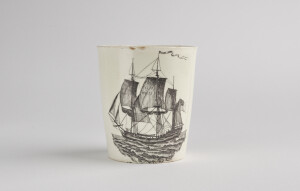 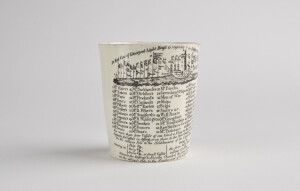  | SHORT DESCRIPTION: Creamware beaker without handle. The beaker is 3-7/16” height and 3-1/8” diameter at the top and 2-⅜” diameter at the base. The beaker is in good condition with some random staining and minor chips near the rim. The beaker is decorated with black transfer-printed images. On one side is a black transfer-printed image showing a port broadside view of a full-rigged British merchant ship under sail. The sails set include a flying jib and jib on the bowsprit. On the foremast a fore topsail (the foresail is furled). There is a fore topgallant sail mast and yard, but no sail appears. Between the foremast and mainmast a quadrilateral main topmast staysail is set. On the mainmast the mainsail is furled, the main topsail is set. The mast and yard of the main topgallant sail are visible but there is no sail. On the mizzenmast the mizzen topsail and mizzen sail are set. A long pennant with a cross of St. George at the hoist and forked fly end is flying from the mainmast. Interestingly the pennant is flying towards the stern rather than the bow. A British flag flies at the stern, again, it is pictured flying in the wrong direction. The sea underneath the ship is wrapped in a rococo design. On the opposite side is a black transfer-printed view of the signal tower and flagpoles at Bidston Hill (the windmill is not included), including flags numbered from 1 to 44 sitting to the north and south of the lighthouse. The transfer-print is titled “An East View of Liverpool Light House & Signals on Bidston Hill 1788.” Beneath the image is a numbered list of the shipowners keyed to the flags and a set of instructions for reading the signals. Reading from left to right, the names, in four columns, are: 1. Mr. Slater's; 2. Mr. Baker's; 3. Mr. Watt's; 4. Mr. Kent's; 5. Mr. Fisher's; 6. Mr. Galley’s; 7. Mr. Bolton's; 8. Mr. Ingram's; 9. Mr. Ashton's; 10. Mr. Kenyon's; 11. Mr. Bent's; 12. Mr. Backhouse's; 13. Mr. Dickson's; 14. Mr. Freeland's; 15. Mr. Copland's; 16. Messrs. Earle's; 17. Mr. R. Fisher's; 18. Mr. Staniforth's; 19. Mr. R. Wilding's; 20. Mr. Brooks's; 21. Mr. France's; 22. Mr. Boats's; 23. Mr. Birch's; 24. Greenland Ships; 25. Men of War; 26. Ships; 27. Brigs; 28. Snows &c; 29. Well Boats; 30. Mr. Gregson's; 31. Mr. Tomlinson's; 32. Rawlinson & Co.; 33. Mr. Tarleton's; 34. Mr. Orange’s; 35. Messrs. Lakes's; 36. Mr. Jackson's; 37. Mr. Kewley's; 38. Allanson & Barton; 39. Mason & Bourn; 40. Belfast Traders; 41. Dublin Traders; 42. Willock & Co.; 43. London Cheese Ships; and 44. Harper & Brade. Underneath the columns are the instructions for reading the signals: For more than four Vessels of one kind a Flag on the proper staff., Signals for Vessels in distress, or on shore in the Rock Channel or about Hoyle, On the Oblique Pole to the Southward of the Light House, Coming in, Ship [symbol of a ball with a flag half Mast], Brig [a symbol of a cone, broad end up, and flag at half mast], Snow or small Vessels [symbol of a cone with point up and a flag at half mast], Going out, The same [as ship] but a broad Pendant instead of a Flag, signals for Distress in Formby Channel the same as above on the Oblique Pole to the Northward of the Light House. The beaker is unmarked leaving the manufacturer(s) identified. In Transactions of the Historic Society of Lancashire and Cheshire, session 1880-1881, volume XXXIII, Charles T. Gattey discusses local manufacturers in the article “The Liverpool Potteries.” Gatty indicates the firm of John Sadler and Guy Green on Harrington Street were early producers of printing on pottery. Unfortunately, Sadler retired in 1770 which predates the estimated date of this beaker (1788). Gatty does indicate that “much of the ware upon which their [Sadler and Green] prints appear were made by Josiah Wedgwood. According to printedbritishpotteryandporcelain.com, “From about 1761 Wedgwood was sending creamware to Liverpool to be printed at the Sadler workshop. This grew into a large business and continued into the period when [Guy] Green was running the printing business alone.” As there weren’t too many firms actively printing on pottery in Liverpool at the time, it’s possible this jug was one of those printed and decorated by Green (who didn’t retire until 1799) for the Liverpool market. If, as printedbritishpotteryandporcelain.com states, the business between Wedgwood and Green was large, it’s possible that Green bought creamware from Wedgwood for the printing of the Bidston Hill images. Of course, this is merely conjecture at this point. NOTES: According to bidstonhill.org.uk in 1763 a signal station was built on Bidston Hill and functioned as a complicated early warning system using flags and flagpoles. Bidston Hill can be seen for many miles in all directions and the windmill there served as a navigational daymark long before the erection of the signal station. In 1778 there were 14 flagpoles and by 1820 there were 195 poles. Each flagpole was 30 ft (9.14 m) tall and made of Baltic Pine. As merchant ships rounded the Point of Ayr or sailed past Formby Point the ship would be spotted and identified. Flag runners were employed to watch for ships and had 11 minutes to raise the correct company’s flag on the right pole, followed by the correct cargo flag. This enabled supervisors in the docks to ready their workforce to unload the ship (and it meant the workers would be paid only for the time they spent working). The flag signaling station operated until about 1840. A lighthouse was built at the station in 1771 by Liverpool's dockmaster William Hutchinson as a navigational aid. The lighthouse was designed to work in conjunction with the Leasowe Lighthouse to form a pair of leading lights that helped ships avoid sandbanks in the channel to Liverpool. In his 1795 history of Liverpool, James Wallace wrote: “There are at this time fifty-eight [signals], of which forty-nine belong to particular merchants, the remainder are to distinguish and shew if the vessels coming in are Greenlanders, men of war, or if the vessel is ship, brig, or snow; there are also immediate signals to the town of all vessels seen in distress in either of the channels, that thereby speedy assistance may be given.” NOTES: According to printedbritishpotteryandporcelain.com, the earliest version of the Bidston Hill image is dated 1788 and has 43 numbered flags. A second version with 47 numbered flags was also produced in 1789. On the 1789 image, Mr. Galley's name appears but Mr. Orange's does not indicated the image was produced sometime between January (Orange's death) and April 1789 (Galley's death). In 1793 a third version with 56 numbered flags was produced and after France declared war on Britain a fourth version with a new flag indicating “Enemies” was added. With the date 1788 and a list of 44 names, this beaker seems to be one of the earliest examples of the Bidston Hill decorated creamware. NOTES: The flags in the image represent a mix of Liverpool merchants, many of which are engaged in the slave trade. Research has been unable to provide the exact identities of some of the men/companies. 1) Gill Slater was a Liverpool merchant who made 48 slave trading voyages between 1759 and 1793. Slater was part owner of the ships: Richmond, Hannah, Prince Tom, Betty, York, Lancashire Witch, Ingram, Kitty, Will, Sportsman, President, Defiance, Tartar, Wasp, Edward, Saint Leger, King George, Anna, Chesterfield, Comet, Mary (wholly owned), Seaflower, Commerce, Isabella and Tammerlane. He appears to have conducted other business as he was part owner of a fishing smack named Liver. Slater also conducted privateering voyages during the American Revolution. In 1777 Slater was part of a committee formed to draw up a plan for the better regulation of the slave trade. 2) Peter Baker (1731-1796) was a Liverpool merchant and slave trader in partnership with his son-in-law, John Dawson. According to the Slaving Voyages database, between 1768 and 1789 Baker was part owner of ships on 54 slaving voyages. He and Dawson started slaving voyages together in 1781 (both were active before that point, just not together). According to Stephen Behrendt in “The Captains in the British Slave Trade from 1785 to 1807” between 1783 and 1792 Baker and Dawson was the largest company of slave traders in England and had a contract with the Spanish government to supply enslaved peoples to the Spanish colonies between 1785 and 1788. Behrendt states that even after the Spanish market opened to all merchants in 1788, Baker and Dawson remained the leading British slave trader to the Spanish Caribbean. Captain William Sherwood was given command of Baker & Dawson's Princess Royal (596) from 1786 to 1788, Brothers (325) in 1789, Garland (525) in 1790 and 1791, and Elliot (271) in 1792. Between 1785 and 1795 Joseph Fayrer sailed four voyages for Baker & Dawson, William Forbes and Joseph Withers each sailed five, and Thomas Molyneux commanded six. Ships partially or wholly owned by Baker and Dawson included: Mosley Hill, Princess Royal, Hero, Champion, Telemachus, Prince, Elliott, Garland Sisters, Young Hero, Brothers, Blaydes, Carnatic, and Mentor. According to William Gomer in History of the Liverpool Privateers and Letters of Marque: With an Account of the Liverpool Slave Trade Baker and Dawson had a shipbuilding firm on the Estuary Bank. 3) Richard Watt (1724-1796), a Liverpool merchant. According to History of the Liverpool Privateers and Letters of Marque: Richard Watt came to Liverpool from Standish, near Wigan, around 1740 and was hired by Mr. Geoffry Walley to look after his horse and chaise. Watt was sent to evening school and Walley advanced him to the counting house and employed Watt as a supercargo to Jamaica. Watt settled in Jamaica and made a large fortune. Watt returned to Liverpool in August 1782 as head of the firm Messrs. Watt and Walker. Watt died in 1796 leaving a fortune of around half-a-million pounds to his two nephews, Richard Watt and Richard Walker. 4) Richard Kent, Liverpool merchant. The Voice of Liverpool Business: The first chamber of commerce and the Atlantic economy, 1774-c.1796, by R. J. Bennett, R. J., lists Ken as a timber and general merchant and ship-owner with a salt manufactory at Northwich and a white lead manufactory. His primarily market was America. 5) John Fisher (1740-1791), Liverpool merchant and periodic slave trader. R. J. Bennett describes him as a major ship-owner, ship builder and merchant, conducting some slaving. Fisher owned ships (Betsey, Assistance, Philip Stevens and Robust) that conducted six slaving voyages between 1787 and 1792. 6) John Galley, (died April 1789) Liverpool merchant and slave trader, shareholder in ships conducting 29 slave trading voyages between 1770 and 1789. Owned at least one privateering vessel during the American Revolution (Emperor). 7) John Bolton (1756-1837), major Liverpool merchant, slave trader and slave owner (with Staniforth, Brooks Slater and Ryan). Between 1788 and 1807 Bolton was part owner of ships that conducted 68 slaving voyages (President, Comet, Abigail, Bolton, Gudgeon, Surprise, Maria, Betsey, Cart, King George, John, Christopher, and Elizabeth). 8) Francis Ingram (1793-1815), Liverpool merchant, slave trader and privateer. Merchant in tar and pitch, ship owner (with Earle, Leyland and Staniforth), slaver, and banker. Owner of the privateer Enterprize/Enterprise in 1779/1780. Company Messrs. Francis Ingram & Co. Started slaving in 1761, between 1785 and 1804 partly owners ships conducted 57 slaving voyages (Kitty, Darnall, Hornet, Ingram, Brooks, Mary, Dick, Elliot, Blaydes, Aeolus, Albion, Clemison, Ann, Onslow, George, King George, Liverpool Hero, and Huges). 9) Nicholas Ashton (1742-1833), Liverpool merchant exporting salt and coat to America. Ship owner. Saltworks at St. Helens and Dungeon. Coal mining and salt at St. Helens with George Case. Co-owned the privateer Marchioness of Granby (260 tons, 20 guns) with the Marquis of Granby. Messrs. Ashton & Co owned a small privateer Lady Granby (45 tons, 10 guns) and Jenny (80 tons, 12 guns). 10) James Kenyon, Liverpool merchant and cotton importer. Fourth largest cotton importer in Liverpool. A. Krichtal, in an unpublished masters thesis titled Liverpool and the Raw Cotton Trade: A Study of the Port and its Merchant Community, 1770-1815 identifies James Kenyon as the 4th largest Liverpool cotton importer from the West Indies, 1786-1815, sourcing 5,277,880 lbs in this time period, and cites his main cotton supply area as Barbados. He was particularly active in the 1790s when he was the 3rd highest Liverpool cotton importer from all locations, sourcing 4,403,000 lbs. Krichtal also indicates he was one of several major Liverpool cotton importers who, while not heavily invested in slave trading, did become strongly involved in the shipping of plantation supplies to the Caribbean. 11) Robert Bent (1744/1745-1831/1832) Liverpool merchant and slave trader. MP for Aylesbury. Slave trader with Ellis Bent. He was a major slave-trader with 38 voyages recorded in the 1790s and early 1800s, most from Liverpool but with three from London. Slaving Voyages database lists 37 voyages between 1783 and 1804 (ships: Stanley, Lady Penrhyn, Renown, Ellis, Clemson, Abigail, Susannah, Little Ben, Ariel, Chambres, Ocean, Britannia, William, King William, and Hector). 12) Mr. Backhouse: there were four merchants named Backhouse in Liverpool Registry of Merchant Ships (Daniel, John, Stephen, and Thomas). A likely candidate is Daniel Backhouse (1741-1811) who was a Liverpool merchant and major ship-owner (with Tarleton and others) who also engaged in slaving. He was a Chamber of Commerce member. Daniel was also part owner of the privateer ship named Jenny (140 tons) as well as a privateer brig named Jenny. 13) William Dickson Sr. (1740-1802), Liverpool merchant and slave trader. Part or whole owner ships conducting 32 slaving voyages between 1783 and 1800 (ships: Benson, Henrietta, Mary, James, Joshua, Commerce, Tamerland, Sarah, and Vanguard). He was joined by his sons in shipowner/slaving in 1796. 14) Peter Freeland (1748-1795?), Liverpool Merchant and one time slave trader (ship named Edward in 1784 ). In 1779 Peter was a 1/16th owner of the privateer Enterprize/Enterprise. He also owned a privateer named Basil. 15) John Copland (born 1727?), Liverpool merchant and slave trader. Copland was the part owner of ships that conducted 41 slaving voyages between 1780 and 1794 (ships Kitty, Oronoko, Perseverance, Preston, Betty, Thomas, John, Peggy, Christopher, and Nancy). 16) Probably Thomas (1754-1822) and William Earle (1759-1839) (firm of T & W Earle & Co.), sons of William Earle (1721-1788), a major Liverpool merchant who operated a packet service to Leghorn (Livorno). He was a major ship owner with Hodgson, Ingram and Leyland. William (Sr.) began making slaving voyages in 1754. A Ralph Earle joined William in partial ownership of some vessels starting in 1763 (brother born 1715). Thomas's first slaving voyage is 1768 and all three men had part ownership of Dispatch, Mentor, and Ann. William Jr.'s first slaving voyage was Preston in 1780 with Thomas Jr. and William. The Earle’s were full or part owners of ships conducting 168 voyages between 1754 and 1805. According to Nichoas Radburn in “William Davenport, the Slave Trade, and Merchant Enterprise in Eighteenth Century Liverpool” William Earle was the sixth most active slave trader in the 1740-1790 period in Liverpool. 17) Ralph Fisher (1746-1803), Liverpool merchant and prolific slave trader. Part owner of ships that conducted 93 slaving voyages between 1782 and 1801. 18) Thomas Staniforth (1735-1803), Liverpool merchant, slave trader and politician. Chamber of Commerce deputy chair in 1777 and 1781, Lord Mayor of Liverpool 1797-1798. Part owner of ships that conducted 79 slaving voyages between 1758 and 1806. See: Chapter 3, Portrait of a Slave-Trading Family: The Staniforths of Liverpool, by Jane Longmore in Britain’s History and Memory of Transatlantic Slavery. 19) Richard Wilding (died 1797), Bidston Hill lighthouse keeper and slave trader. According to Dr. Stephen Pickles, Richard Wilding was the keeper of Bidston lighthouse until his death in 1797. He states: We know that Richard Wilding had one of the flags on Bidston Hill (indeed it is referred to in a Letter of Marque in Gomer William's book "History of the Liverpool Privateers and Letters of Marque with an Account of the Liverpool Slave Trade 1774-1812.") Part owner of ships that conducted 26 slaving voyages between 1777 and 1791. 20) Joseph Brooks Jr. (1746–1823), Liverpool merchant, major shipowner, and slave trader (with Ingram, Stanifordh, Carruthers, Slater and Ryan). May have also been owner of a privateer in 1779. Bailiff of Liverpool in 1784 and 1802. Co-owner of the slave ship Brooks/Brookes which was the subject of a broadside by abolitionist William Elford in 1788. 21) James France (1728-1795), Liverpool merchant. Owner of several privateers (James, Tyger). In partnership with Thomas Hayhurst in France & Co./France & Nephew. The company also owned several privateers (Ellen, Mary Fearon). Imported sugar rum and other commodities from the West Indies. In 1793 James France initiated the construction of a gigantic 14-story warehouse situated in the Goree area of Liverpool (between Water, Brunswick and Drury streets). It became known as one of the Goree Warehouses. This area was later named Back Goree. The warehouse is recognizable in late 18th century images by its immense size and a large weathervane in the shape of a ship that capped the building (burned down in 1802). 22) William Boats (1716-1794) According to “History of the Liverpool Privateers and Letters of Marque: With an Account of the Liverpool Slave Trade” William Boats/Boates (nicknamed “Billy Boats/Boates”) had been found in a boat as a child and was brought up by the person that found him who gave him the surname Boats. He was placed in the Blue Coat School and then served an apprenticeship at sea. He rose to be the commander of a slave ship and eventually became one of the leading merchants and shipowners of Liverpool. In 1779/1780 Messrs. Boats and [John] Gregson owned two privateers (Ellis (340 tons, 24 guns) and Gregson (250 tons, 24 guns). Boats was responsible for 157 slave voyages. 23) Joseph Birch (1755-1833) Liverpool merchant, slave ship owner and politician; MP for Nottingham. Birch was associated with nine voyages from Liverpool and owned stock in the East India Company. Member of the West India Planters and Merchants committee. 24) Greenland ships are ships involved in whaling. 25) Men of War are the signal for Royal Navy warships. 26) Ships is a generic category for all other ships. 27) Brigs are fast, maneuverable two-masted ships. 28) Snows are similar to brigs, but with the addition of a secondary mast immediately behind the main mast. 29) Well boats are cod smacks or boats with wells to keep fish alive until delivery. 30) William Gregson Sr. (1721-1800), Liverpool merchant and prolific slave trader. Between 1745 and 1801 Gregson and his sons (John and James) conducted 213 slave voyages between 1745 and 1801. Gregson served as Lord Mayor of Liverpool in 1762. In his later career he branched out into banking and insurance. According to Carolyn Dalton in “Memorial to Zong: The Gregson Syndicate” Gregson's vessels carried 58,201 Africans of whom 9,148 died on board. The Gregson’s, along with Edward Wilson and James Aspinall were the owners of the slave ship Zong. On a voyage in 1781 the ship missed its destination in the Caribbean thanks to a navigational error and spent an extra three weeks at sea. Drinking water grew short and some of the enslaved Africans and crew became sick. The crew threw approximately 131 Africans overboard so the merchants could claim insurance money for the “lost cargo.” The case came to symbolize the horrors of the Middle Passage and strengthened the abolition movement. 31) John Tomlinson, Liverpool merchant trading in Lisbon/Oporto. A man named John Tomlinson made 51 slaving voyages between 1759 and 1787. No slaving voyages attributed to John Tomlinson were made after 1787 and only one ship name in the LRoMS appears on a slaving voyage with Tomlinson's name. The following advertisements were found: Leeds Intelligencer for a voyage of the Grape to Lisbon in September 1786; in Gore's Liverpool General Advertiser, May 28, 1795, a voyage for the ship Sisters to Lisbon and ship Brothers to Oporto); the same source dated August 20, 1795 documents a voyage of the ship Rochdale to Lisbon. It seems odd that such a prolific slave trader suddenly stopped and became a merchant to Lisbon/Oporto. I think there might be a mistake here or maybe the business moved from father to son and the son was not a slave trader? Since there were no slaving voyages after 1787 and the first ceramics with Bidston Hill image didn't come out until 1788, I'm limiting John Tomlinson to merchant. 32) Rawlinson & Co. There were a number of Rawlinson’s involved in business in Liverpool. Henry Rawlinson (1743-1786), agent for the Chamber of Commerce of Liverpool 1782 and MP for Liverpool (1780-1784), and a merchant who owned property in the West Indies. Henry was a partner in Rawlinsons & Chorley with John Chorley but I found no evidence this company existed after 1776). Henry is documented as holding shares in the slave ship Molly along with Abraham Rawlinson Jr. in 1776. Henry died two years before the first pitcher with the Bidston Hill image was produced so it seems unlikely this is the right man. Abraham Rawlinson (1738-1803) was an English politician and merchant, but he traded out of the port of Lancaster. I also found an A. and J. Rawlinson in business together in 1781, possibly in Liverpool. 33) Mr. Tarleton. There were a number of men named Tarleton active in Liverpool at the time this pitcher was produced. Thomas Tarleton (1753–1820) [Centre for the Study of the Legacies of British Slavery: Liverpool slave-trader and slave-owner on Grenada. Other brothers were: John Tarleton, Banastre Tarleton and Clayton Tarleton. Thomas Tarleton & Co. were also shown as the owners of La Resource in Demerara in 1798. Thomas Tarleton had been paid £68,000 on his withdrawal from the slave-trading and West India mercantile partnership with John Tarleton and Daniel Backhouse [at a date not given].], John Tarleton (1755–1841), Clayton Tarleton, John Tarleton Jr., and Jane Tarleton, slave traders. 34) William Orange (1721-1789), a Liverpool merchant engaged in the Dublin-Liverpool packet service. The Slaving Voyages database lists William Orange as a shareholder in two ships that conducted four slaving voyages between 1772 and 1774. I found a report of a William Orange who died on January 23, 1789 and was buried at St. James in the District of Toxteth, Liverpool. In his 1991 master’s theses dissertation “Economic Development and Political Authority: Norfolk, Virginia merchant-magistrates, 1736-1800” by Thomas Costa documents the history of a man named William Orange that seems to fit our merchant. According to Costa a man named William Orange joined the Royal Navy in 1740. His duties brought him to Virginia where he married in 1743 and settled in Norfolk. Commercial success elevated Orange to the position of borough common councilman by 1750. By the American Revolution, Orange’s holdings had grown to 21 dwellings, 11 warehouses, 3 sheds and a “very large and valuable wharf.” In 1766 Orange was associated with the Sons of Liberty. In 1767 he resigned his council seat and in 1768 Orange became an “inoculationist” (i.e. a supporter of inoculating people against smallpox). His involvement in the smallpox inoculation dispute led him to leave the colony and return to England probably before June 1771 [when he disappeared from the list of tithable persons in Norfolk]. In January and February 1776, fires set by British troops caused the nearly complete destruction of Norfolk. Orange lost forty buildings and property amounting to £4,792. Orange had moved to Liverpool, Lancaster, England and was a merchant at 27 Duke Street, Liverpool. His will was dated June 1789 (probate; died January 23, 1789). 35) Messrs. Lake were William Charles Lake (1753-1836), Thomas Lake, Richard Lake (of Jamaica), Liverpool merchant, Irish shipping packet service, and slave traders who were part owners of ships conducting 12 slaving voyages between 1773 and 1788. William Charles Lake was the son-in-law of William Orange. When Orange died in 1789, William Charles Lake & Company took over Orang'es Liverpool to Dublin packet service. 36) John Jackson, Liverpool merchant, part owner of slaving ships between 1770-1775. I’m not entirely sure this is the right gentleman. 37) Patrick, John and Philip Kewley, Liverpool merchants and slave traders. Between 1784 and 1787 John was part owner in ships conducting 13 slaving voyages. Between 1788 and 1800 the John and Patrick were part owners of ships conducting 40 slaving voyages. John was part owner of ships conducting 3 slaving voyages between 1801 and 1803. Philip’s name does not appear as the owner of ships conducting slaving voyages. Philip was probably a member of Liverpool’s Chamber of Commerce. 38) John Allanson, Thomas Barton (1753-1799), William Barton (1755-1826, lives in Barbados), Liverpool merchants and slave traders. Early 1792 Allanson sold all shares to Bartons; 6 slaving voyages between 1779 and 1784 (nearly all Allanson, 1 in 1784 includes Thomas), 1 voyage in 1784 by Thomas; 2 slaving voyages between 1801-1802 by William partnered with John Higginson. The Bartons specialized in the import of sugar, cotton, and spirits from the island of Barbados to Liverpool. Allanson and Barton obtained letters of marque for their ship captains so they could attack and capture French ships after 1793. 39) Edward Mason and Cornelius Bourne, Liverpool merchants and slave traders (before 1785). Mason & Bourne made 10 slaving voyages between 1768 and 1785; It seems they may have stopped being partners in 1791; found advertisement for the men in the Manchester Mercury June 9, 1789 (selling cyder and Perry), but nothing after that. 40) Belfast traders were cargo ships traveling between Liverpool and Belfast. 41) Dublin traders were ships trading with Ireland. 42) Found William Willock & Co in Chester Chronicle (Chester bumps up against Liverpool) October/November 1775; July/August 1776; March/November 1777; August 1778; August 1779; October 1781; August/October 1782; September 1784; January/May/July/October/December 1785; July 1787; January 1801; possibly active through 1810; Based on the advertisements I'm assuming the company represented on the jug is William Willock & Co. who were simply merchants and not slave traders during the 1788 to 1800 time period. 43) London Cheese Ships were ships coming to collect Cheshire cheese which was exported from Liverpool to London. 44) William Harper (1749–1815) and Robert Brade (1747–1815), slave traders. Owners or part owners of ships conducting 53 slaving voyages between 1784 and 1800. Brade's last slaving voyage was in 1799. William continues in the slave trading business without Brade as part owner in ships that conducted 23 slaving voyages between 1801-1807. NOTES: Notes made in the China File by Nola Hill - work done in the '40's or early 50's per Harold Sniffen, 12/7/81.. East View of Liverpool Lighthouse and Signals on Bidston Hill, 1788 - with 44 signals around it. Each signal is numbered and below is a key. c. 1800 Reverse - British Frigate Leeds ware Drinking mug 3-1/2 x 3 | CL5679 | |||||||
| 40 |  | SHORT DESCRIPTION: The scene shows Westminster from a West facing view of the River Thames with the very identifiable figure of Westminster Abbey in the background and the river bustling with a multitude of small vessels. The accompanying text focuses, primarily on the history of Westminster Abbey and the monastery. Published in The Universal magazine. V.11. No. 73. August 1752, Image found on page: 48. NOTES: (R. Wyatt, 5/3/2001) From: Universal Magazine, The Universal Magazine of Knowledge and Pleasure was a monthly publication, June 1747 to December 1803. It contained news, letters, debates, poetry, music, biography, history, geography and other arts and sciences. Making use of plates, maps, and diagrams, it was prepared for the instruction and entertainment of the gentry, merchants, farmers, and tradesmen. (TMM Library AP3 U 58 C) SEE: LE 761, LE 767, LE 775, LE 849, LE 867, LE 1010, LE 1051 ADDITIONAL INFORMATION: Text that accompanies image: “An Account of the County of Middlesex (Page 24, Vol. XI) Continued. Illustrated with a curious perspective View of the City of Westminster In order to proceed regularly in our survey of the public structures in the cities of London and Westminster, we shall begin with those in the latter, and first give an account of the abbey-church or St. Peter, that truly venerable pile, where most of our British monarchs have had their sceptres and sepulchres. An Abbot of Westminster, willing to ascertain the origin of his abbey, by making the same coeval with Christianity, tells us, that St. Peter the Apostle founded an oratory in the island of Thorney, now called Westminster; but that story and chapel having no other foundation than that of a dream, or nocturnal imagination of Wulfine, the said Abbot, in the reign of Edward the Confessor, it deserves no animadversion. However, a certain monk of this abbey, willing to confirm the fable of the oratory, acquaints us, that the same [was] destroyed in the persecution under [Dioclesian] the Emperor, and, a Pagan [temple] being erected on the site there-[of] it was dedicated to Apollo; but [the] said temple being some time after destroyed by King Lucius, he erected [a] Christian church in its stead, and am[ply] endowed the same. This is of a [...] with the former; for the great difference among authors, in respect to [the] time and place, when and where the said King reigned, has occasioned [our] learned and most judicious histories justly to suspect there ever having [been] such a King in Britain, as Lucius. Other monks of this monastery tell [us] that the Pagan Saxons, soon after [their] arrival in Britain, having expelled the Britons, and destroyed their churches, erected a temple in this place [..] to Apollo; which being destroyed by Sebert, King of the East Saxons, upon his conversion to Christianity, he [erected] on the site thereof a Christian church, in the year 604. But Bede, who was careful in giving an account of the churches, erected at that time, being silent in respect to this, it has occasioned divers learned men to question his being the founder; more especially considering that the accounts thereof are given by legendary writers since the conquest; and that the ancient charters, said to be granted to the said monastery, cannot be relied on. Be these things as they will, we shall in this great uncertainty join the multitude in allowing Sebert to be the founder; and not, according to a certain author, a citizen of London. Mr. Dart, in his History and Antiquities of Westminster, injuriously reflects upon Holingshead and Fox, by making them the authors of the said citizen’s being the founder of this church; whereas had he been a little more careful in making his quotation from Ranulph Cestrensis, he would have discovered him to have been the author, and not them. This church was no sooner finished, than a miracle, which the monks seldom want, was judged necessary for its consecration; which being one of the first magnitude, we shall subjoin the same for the better detecting the wicked impositions of the monks. Mellitus, Bishop of London, intending to consecrate this church, was prevented by St. Peter, who, the night before the intended consecration, called upon Edricus, a fisherman, who dwelt upon the opposite bank of the river Thames, and intreated him to carry him across the river, which was very high by prodigious rains, to Thorney, where he no sooner entered the church, than it was illuminated in a very extraordinary manner; and, whilst a celestial choir of angels performed the most delightful and inimitable harmony, the Apostle accomplished the consecration; and, being returned, discovered [pg. 50] himself to Edricus, whom he desired to acquaint Mellitus, with what he had seen and heard, in order to prevent a second consecration. And to corroborate what he said, ordered Edricus to throw his net into the river, which was no sooner performed, than it was so overcharged with salmon, that it was with great difficulty he got it whole on shore; and Peter assures him, that, for the future, neither he, nor any of the fraternity, should ever fail of catching great numbers of that sort of fish in the said river, provided they would agree and continue to pay the tythe thereof to this his church. The place where this magnificent and stately structure is situate, was anciently an island, which, from its being overspread with thorns, received the appellation of Thorney, or the island of Thorns; and the branch of the river which surrounded the same denominated Long ditch, had its outflux from the river Thames, near the east end of Manchester-court, Channel-row; and, intersecting King’s-street glided along where Gardiner’s-lane is situate, to Long ditch, a street so called, wherein the name of this ancient water-course is still preserved; and crossing Tothill street, a little west of the Gate house, continued its course along the fourth wall of the abbey garden, to the Thames, where now the common sewer is,which was erected over it. This Monastery, like most others of the kingdom, being destroyed by the cruel ravages and depredations of the Pagan Danes, it was rebuilt by King Edgar, who not only endowed the same with divers lands and manors, but likewise, by his charter, anno 969, it granted many ample privileges. This church being again reduced to very great extremities by Danish cruelties, it was restored to a much more flourishing condition than ever, on the following occasion. Upon the demise of Edmund Ironside, Cnut, King of Denmark, in the year 1017, usurped the crown; where upon Edward, brother to the deceased prince, was necessitated to seek refuge in Normandy, where labouring under very great hardships, he made a vow that if God would be pleased to put an end to his sufferings, and restore him to the throne of his ancestors, he would go on pilgrimage to Rome to visit the sacred relicks of St. Peter the Apostle. Edward’s desire being soon after accomplished, he bethought himself of the solemn obligation le lay under; and, having a resolution of performing the same, summoned divers of the Nobility, both spiritual and temporal, for settling a regency during his absence; they wisely considering the danger the nation was exposed to by the pretensions of the Danes, judged it not proper for the king, at that critical juncture, to leave the kingdom; therefore it was resolved to send an embassy to Rome to obtain a dispensation for Edward, for not performing his vow; which the Pope granted, upon condition that all the money, intended to be laid out in the King’s journey and voyages, should be appropriated to charitable uses, and to be employed either in repairing the old monasteries, or erecting a new one in honour of St. Peter. And the choice thereof being left to the King, a revelation was judged necessary to determine the same; which was dextrously brought about by one Wulfine, a monk belonging to this convent, who gave out that St. Peter had appeared to him in a vision, and told him that it was his pleasure that the King should repair this monastery (whereof he was a patron) for the entertainment and better accommodation of the monks; and to endow the same with revenues sufficient of their support, which place would then become the house of God and the gate of heaven. This device succeeded according to wish; for the simple and bigotted King was no sooner acquainted therewith, than he embraced it as the immediate command of heaven; pursuant to which, he forthwith set about the work, [pg. 51] by appropriating for that purpose on tenth of his estate both real and personal; and, pulling down the small and ruinous building, erected in its stead a handsome structure; and, summoning his Ministers and Nobility, caused it to be consecrated on the 28th of December, anno1065, with the greatest pomp and solemnity; and, by several charters, not only confirmed all its ancient rights and privileges, but likewise endowed the same with many rich manors, and additional immunities , viz Sac and Soc, Thol and Theam, Infangtheof, Gritbrich, Hamsoken, Pontage, Murage, and Forstal. And that all the lands, tenements, and possessions thereunto belonging in London and elsewhere, should be exempt from all jurisdiction whatsoever, other than that of their own; and the convent to be free from the authority of the Bishop of London; and the church thereof, by the bull of Pope Nicholas the Second, continued a place for the inauguration of the Kings of England. And by the said Edward’s charter of sanctuary, it became not only an asylum for bankrupts, &c but likewise a refuge for traitors, murderers, thieves, and the most abandoned miscreants, who were suffered to live there in impunity, and open defiance of justice, to the great reproach of the pretended Confessor. However, the great immunities in the charter drew people from all parts, which occasioned the refugees to increase so fast, that there was not room sufficient in the abbey church for the accommodation of the numerous inhabitants, without incommoding the monks; wherefore Edward caused a church to be erected on the north side of the monastery, for the use of its inhabitants, and dedicated the same to St. Margaret William the Conqueror, out of the great veneration he bore to the memory of his late dear friend Edward, no sooner arrived in London, than he repaired to this church, where he offered a sumptuous pall as a covering to his shrine, and fifty marks of silver, together with a very rich altar cloth, and two caskets of gold; and the Christmas-day following was solemnly crowned therein, which was the first coronation solemnized in this place. William was a great benefactor to this abbey, for, by no less than sixteen charters, he not only confirmed all their ancient rights and immunities, but also granted them greater privileges and additional revenues. In the year 1189, Richard the First was crowned in this church with the utmost pomp and magnificence, and, though it undoubtedly was the most sumptuous coronation of any till that time solemnized in this kingdom, yet it would have been much more glorious, had it not been staines with a barbarous massacre and robbery, which happened thus: Though the Jews, by a royal edict, were strictly injoined not to appear at the coronation; yet many of them repaired hither with presents, but whether out of respect, or curiosity, is uncertain; be that as it will, the populace were so highly incensed at this proceeding, that they fell upon them with a diabolical fury, and, in driving them out of the church, killed some, and maimed others; nor did the villainy stop here; for a rumour being spread, that the King had commanded all the Jews to be destroyed, this horrid report flying to the city of London, the populace, with a redoubled fury, murdered all that came in their way, broke open and pillaged all houses easily to be entered, whilst the strong and more defensible they destroyed by fire. In this detestable scene of villainy, many Christians became equal sufferers in their fortunes with the unhappy and distressed Jews. That the priests were the somenters of this inhuman and wicked insurrection, is not to be doubted, seeing many of them in their writings have not only excused, but applauded this cruel and barbarous massacre, as an act truly meritorious in rooting out the enemies of Christianity. But the King, not being of the same opinion, sent a number of his Officers into the city [pg.52] of London, where apprehending the principal ringleaders, he caused them forthwith to be hanged according to their deserts. Henry the Third had the memory of Edward the Confessor, the builder of this conventual church, in so great veneration, that he was thereby induced to erect a chapel at the east end of the same; the first stone of which was laid in the year 1221; and, when finished, dedicated it to the VIrgin Mary. Some time after, Henry, being informed of the great decay of the said church and steeple, caused the whole to be take own, anno 1245, in order to rebuild the same in a more spacious and magnificent manner; and to which end and other purposes, bethought himself of ways and means to raise money: and, being accustomed to fleece the citizens of London, though no way so eligible for the attaining his end, as the having recourse to his former practices; wherefore he proclaimed a fair to be held at Westminster for the space of fifteen days, to commence annually on the 13th of October. During which time he strictly injoined the Londoners not to open their shops, or to carry on any trade within nor without doors in the city; wherefore they were necessitated to buy off the said fair at an exorbitant price of two thousand pounds in silver, which he laid out in rebuilding this church. Henry, having built the east and chief part of the abbey-church of Westminster in a very magnificent manner, he caused it to be consecrated with the greatest solemnity in the year 1296; and, having resolved to translate the relicks of Edward the Confessor into his new fabric, to render the solemnity as pompous as possible, not only summoned all the Lords spiritual and temporal, but likewise all persons of distinction from the several cities and boroughs of the kingdom, to attend the intended sumptuous and royal procession. The Illustrious company being assembled, the King and his brother Richard, King of the Romans, began the ceremony, by taking up the shrine, wherein the relicks were deposited, upon their shoulders, in which they were assisted by the Princes Edward and Edmund, together with divers of the principal Nobility; and having brought the same to the place appointed for it, near the altar, the remains of Edward were deposited in a golden shrine, embellished with a variety of jewels of very great value. Henry, out of his great affection to the memory of Edward, gave divers and very rich ornaments toward embellishing the late church; where Strype, through great inadvertence, has given to the present, though the foundation thereof was not laid till two years after. Henry, after a great expence and labour of twenty-seven years, having only carried on the work of this magnificent fabric one pillar west of the cross isles, the manner of construction was varied by subsequent builders, who placed the small decorating columns of eight pillars in brass instead of stone: but, this new method being altered by succeeding builders, those on the west are of a piece with the stones of their respective pillars, which, by divers authors, are said to be of marble, whereas, in fact, they are only common Sussex rag-stones, which the curious, upon examination, will find to be true. Though Henry, and divers abbots, were employed in the execution of this stately structure for the term of thirty-nine years, yet the body of the church was only finished in the year 1285; in which condition it continued until anno 1700; when the said building, by length of time, being greatly decayed, the Parliament granted money toward repairing the same; which, by subsequent Parliaments, has been continued, not only for effectually repairing all parts thereof, but likewise for completely finishing the whole fabric; and, in order to which, the great tower in the center was begin to be erected anno [pg. 53] 1728: but, cash soon after failing, the work was laid aside till the year 1733, when more money was being granted by Parliament. The work was renewed with vigour, and the two towers at the west end have been for some years entirely finished, and make a very beautiful appearance. The year after the founding of the chapel, dedicated to the Virgin Mary by King Henry III, a very great riot happened at Westminster, occasioned by the persidious and barbarous treatment of divers citizens of London, by the Abbot’s steward, at a wrestling match at St. Gile’s in the Fields. But we shall fully treat of that affair in our account of London. Henry, in the year 1275, granted to the Abbot and convent of Westminster a market and fari, which were free from the lavish impositions of the former. Edward the First, as a monument of his having reduced Scotland, in the year 1296, brought from thence the famous marble stone, whereon the Scottish Kings had for many ages been crowned, and wherein the people had places a kind of fatality; and on which was engraved this distich: Ni fallut fatum, Scoti hunc quocunque locatum Invenut lapidem, regnare tenentur ibidem. Edward caused this stone to be fixed under the bottom of a large wooden chair, and presented the same to the conventual church of Westminster, for the use of a priest at divine service; but, whether it was ever employed in that service, we cannot learn; however, it is manifest, that it has been used as the inauguration chair of the Kings of England for many ages. In the year 1299, a fire, which broke out in the King’s Palace, destroyed the roof, and very much defaced the abbey-church, which, by the assistance of the King and his successors, the Abbots were enabled to repair. The royal treasury being kept in the cloister of the abbey-church of Westminster, the same was robbed of a great sum of money; Edward, suspecting the monks to be the robbers, immediately caused the Abbot and forty-nine of them to be apprehended and secures; where they continued in duress till the year after, when Edward, on Lady-day, repaired to the said church, to return thanks to God and St. Edward for his great success against the Scots. On which occasion he gave orders to discharge the monks: however, they were not put in execution tilla week after, out of pique to them, by the persons that were ordered to discharge them, THe English affairs in Scotland have taken a very unhappy turn, Edwars, for redressing the same, caused proclamation to be made in all parts of the kingdom, strictly commanding all persons qualified for knighthood to appear at Westminster and Whitsontide, in order to their receiving all military accoutrements (except such as belonging to the horses) from the King’s wardrobe. The palace, on this occasion, not being capacious enough to contain so great a multitude as then appeared, a camp was formed in the orchard of the Temple in Fleetstreet, in the church of which the Knights kept their vigil; while the Prince of Wales, by his father’s order, did the like in the abbey-church of Westminster, with the young Nobility. The day after, the King having knighted the Price, and created him Duke of Aquitain, he was no sooner invested with that honour, than he repaired to the conventual church, to confer the same honour upon his companions; but, the crowd being so excessive, he was obliged to perform the ceremony upon the altar. In the year 1352, Westminster was by act of Parliament constituted one of the ten towns in England, where the staple, or market for wool, leather, wool-sels, lead, and other staple commodities, [pg. 54] should be perpetually held. How the city of London, at that time, came to be precluded the privilege of the staple is very amazing! Upon the humble petition of the inhabitants of Westminster, Henry the Sixth granted them the waste eater of the royal conduit in his palace by charter. In the year 1502, Henry VIIth caused the chapel of the Virgin Mary, and a tavern adjoining to the east end of the abbey-church, to be taken down, and on the site thereof erected the present stately and most magnificent edifice, denominated by Henry the Seventh’s chapel, at the expence of fourteen thousand pounds! A very great sum, if we consider, that wheat was then sold at five shillings the quarter; which, at a medium of seven years, appears to be but a sixth part of the modern price. Abbot Islip, assisted by several persons of distinction, laid the first stone of this chapel on behalf of the King, whereon was this inscription: Illustrissimus Henricus Septimus, Rex Angliae & Franciae, & Dominus Hiberniae, posuit hanc petram in honore beatae Virginis Mariae, XXIII: Die Januarij, Anno Domini MCCCCCII. & Anno dicti Regis Henrici Septimi decimo-octavio. At the general suppression of religious houses by Henry VIII, this abbey was surrendered to him, by William Benson, the Abbot, and seventeen of the monks, on the 16th of January, anno 1539, at which time it appeared to be near double the value of any other religious foundation in the kingdom; the revenues whereof amounted to 3997l. 6s. 4 ¾ d. per annum, a sum equal to 20,000 l. at present. As this royal abbey far excelled all others in the kingdom, in point of revenues; so did it likewise in respect to plate, jewels, and vestments, the value whereof must have been immense, especially considering that all the weak Princes of this nation stove to exceed one another in their royal donations to this church; besides those of great value given by the Abbots and others. The value whereof was so great, above four hundred years ago, that it occasioned a monk and author of this convent to say, that the royal treasure, or riches thereof, excelles that of any church in Italy. But, as we have not been able to come at an inventory of the same, we cannot ascertain them. The Monastery thus dissolves, henry erected the same into a college of secular Canons, under the government of a Dean, and appointed William Benson, the last Abbon, first Dean thereof: But this establishment proved of no long duration, for, on the 19th of December, anno 1541, henry converted the same into a bishopric, and constituted Thomad Thirlby Bishop thereof, together with a Dean and twelve Prebendaries; and appointed the whole county of Middlesex (the parish of Fulham, immediately belonging to the Bishop of London, only excepted) for its diocese. And, for the better support of the episcopal dignity, increased the revenues of the bishopric, with an addition of the major part of the lands which belonged to the late abbey. On this occasion, Westminster became a city; for the making on which, according to the opinion of the great Lord Chief Justice Coke, nothing else is required, than the appellation of a bishop’s see. But, the bishopric being soon after dissolved, the epithet of the city was thereby lost: However, the same, by compliance, is still continued. Thirlby, having greatly embezzled the revenues of his new bishopric, was therefore, anno 1550, translated to Norwich; and, the new bishopric being dissolved by Edward the Sixth, he restored the government thereof by a Dean; which continued till Mary’s accession to the crown, who, on the 7th of September, anno 1557, restored it to its ancient conventual state, and appointed John Fecknam Abbot thereof. But, upon Queen Elizabeth’s affection, [pg. 55] the monks being again ejected, she, by her letters of patent of the 21st of May, annp 1560, erected the same into a college, under the government of a Dean, and twelve secular canons, or prebendaries; a school master, usher, and forty scholars, denominated the Queen’s, who are educated in liberal sciences preparatory to the university, and provided with all the necessaries of life, other than cloathing, of which, they have only a gown yearly. To this foundation, likewise, belong twelve almsmen, an organist, with singing-men, choiristers, &c. The abbey of Westminster having been only reckoned the second in England, in point of rank, was owing to pope Adrian the Fourth, who being a native of Hertfordshire and sometime a monk of St. Alban’s, for the honour of his own monastery, in the year 1154, among other privileges, granted the same, and ordained, that it should be the first monastery in England, in respect to rank and dignity; tho’ some think that Adrian granted it the preference in honour of St. Alban, the British Protomartyr. Be that as it will, this abbey was almost as far before that of St. Alban’s, in point of grandeur and magnificence, as the difference is between palaces where they are respectively situated [To be continued.] | CL15095 | |||||||
| 41 |   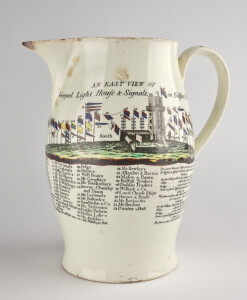 | SHORT DESCRIPTION: Creamware pitcher of baluster form (wide-bellied and tapering to the top rim and foot) with a loop handle. The pitcher is 7-1/16” height and 7” width overall including the spout and handle. The diameter of the rim is 3-⅝” and the diameter of the base, which is slightly splayed, is 3-¾”. The pitcher is approximately 5” width at the center of the bulbous section of the jug. The spout stands about 1-½” from the rim and the loop handle is 2” at its deepest point and 11/16” wide. The pitcher is in fair to good condition with some random staining near the rim. The spout is chipped and darkly stained at the tip. The pitcher is decorated with black transfer-printed images, one of which has been highlighted with colored enamel. On one side is a black transfer-printed image showing a port broadside view of a full-rigged British merchant ship under sail. The sails set include a flying jib and jib on the bowsprit. On the foremast a foresail, fore topsail and fore topgallant sail (which is set but the yard isn’t hoisted) are set. Between the foremast and mainmast a main topmast staysail is set. On the mainmast the mainsail is furled, the main topsail and main topgallant sail are set, but again the yard of the main topgallant sail has not been hoisted leaving the sail billowing. On the mizzenmast the mizzen topsail is set and the mizzen sail is furled. A long pennant with a forked fly end flies from the mainmast. A British flag flies at the stern. Framing the sea at the bottom of the image is a maritime vignette of an anchor, cannon, drum, flag, spears, buoy and other items. On the opposite side is a black transfer-printed view of the signal tower and flagpoles at Bidston Hill (the windmill is not included), including flags numbered from 1 to 52 sitting to the north and south of the lighthouse. The transfer-print is titled “An East View of Liverpool Light House & Signals on Bidston Hill.” The flags are painted in overglaze enamels in red, blue, yellow and white. The lighthouse is painted in shades of gray while the ground underneath is painted in green, yellow and brown/red. At the top of the lighthouse, to the left of flag 31, is the Liver Bird, the symbol of Liverpool. Beneath the image is a numbered list of the shipowners keyed to the flags and a set of instructions for reading the signals. At the base of the spout there is a fragment of a printed compass rose turned on its side to orient north to the right. Half of the rose and the directional arrow were not transferred to the pitcher leaving an odd curved “E”. Reading from left to right, the names, in four columns, are: 1. Mr. Slater's; 2. Mr. Baker's; 3. Mr. Watt's; 4. Mr. Kent's; 5. Mr. Fisher's; 6. Mr. Bolton's; 7. Mr. Ingram's; 8. Mr. Ashton's; 9. Mr. Kenyon's; 10. Mr. Bent's; 11. Mr. Backhouse's; 12. Mr. Bradstock's; 13. Mr. Dickson's; 14. Messrs. Brown's; 15. Mr. Freeland's; 16. Mr. Copland's; 17. Messrs. Earle's; 18. Mr. R. Fisher's; 19. Mr. Staniforth's; 20. Mr. R. Wilding's; 21. Mr. Brooks's; 22. Mr. France's; 23. Mr. Boats's; 24. Mr. Birch's; 25. Mr. C. Jones's; 26. Greenland Ships; 27. Men of War; 28. Ships; 29. Brigs; 30. Snows; 31. Well Boats; 32. Mr. Gregson's; 33. Mr. Tomlinson's; 34. Breeze, Chamley and Dixon; 35. Mr. Leyland's; 36. Mr. Bostock's; 37. Rawlinson & Co.; 38. Mr. Tarleton's; 39. Dublin Packets; 40. Messrs. Lakes's; 41. Mr. Jackson's; 42. Mr. Kewley's; 43. Allanson & Barton; 44. Mason & Bourn; 45. Belfast Traders; 46. Dublin Traders; 47. Willock & Co.; 48. London Cheese Ships; 49. Harper & Brade; 50. Mr. Beckwith's; 51. Mr. Benson's; 52. Dunbar & Hall and one unnumbered name: Mr. Thompson's a Red Flag over a White one, on Mr. Wilding's Pole. To the right of the columns are the instructions for reading the signals. In two sentences in two lines is the text: For more than four vessels of one kind a Flag on the proper staff. For Vessels in Distress or on shore in the Rock Channel or about Hoyle. Followed by the signals for vessels coming in: On the Oblique Pole to the Southward of the Light House; Ship....a Ball with a Flag half Mast.; Brigg.....a cone broad end & Flag half Mast.; Snow or small Vessel dº. small end up & a Flag dº; and the signals for vessels going out: The same as above but a broad Pendant instead of a Flag. The instructions also provide signals for vessels “In Formby Channel”: for vessels coming in: On the Oblique Pole to the Northward of the Light House; Ship.....a Ball with a Flag half Mast; Brigg.....a Cone Broad end up & Flag half Mast; Snow or small Vessel dº. small end up & a Flag dº. Signals for vessels going out: The same as above but a broad Pendant instead of a Flag. The jug is unmarked leaving the manufacturer(s) identified. In Transactions of the Historic Society of Lancashire and Cheshire, session 1880-1881, volume XXXIII, Charles T. Gattey discusses local manufacturers in the article “The Liverpool Potteries.” Gatty indicates the firm of John Sadler and Guy Green on Harrington Street were early producers of printing on pottery. Unfortunately, Sadler retired in 1770 which predates the estimated date of this jug (1790-1792). Gatty does indicate that “much of the ware upon which their [Sadler and Green] prints appear were made by Josiah Wedgwood. According to printedbritishpotteryandporcelain.com, “From about 1761 Wedgwood was sending creamware to Liverpool to be printed at the Sadler workshop. This grew into a large business and continued into the period when [Guy] Green was running the printing business alone.” As there weren’t too many firms actively printing on pottery in Liverpool at the time, it’s possible this jug was one of those printed and decorated by Green (who didn’t retire until 1799) for the Liverpool market. If, as printedbritishpotteryandporcelain.com states, the business between Wedgwood and Green was large, it’s possible that Green bought creamware from Wedgwood for the printing of the Bidston Hill images. Of course, this is merely conjecture at this point. NOTES: According to bidstonhill.org.uk in 1763 a signal station was built on Bidston Hill and functioned as a complicated early warning system using flags and flagpoles. Bidston Hill can be seen for many miles in all directions and the windmill there served as a navigational daymark long before the erection of the signal station. In 1778 there were 14 flagpoles and by 1820 there were 195 poles. Each flagpole was 30 ft (9.14 m) tall and made of Baltic Pine. As merchant ships rounded the Point of Ayr or sailed past Formby Point the ship would be spotted and identified. Flag runners were employed to watch for ships and had 11 minutes to raise the correct company’s flag on the right pole, followed by the correct cargo flag. This enabled supervisors in the docks to ready their workforce to unload the ship (and it meant the workers would be paid only for the time they spent working). The flag signaling station operated until about 1840. A lighthouse was built at the station in 1771 by Liverpool's dockmaster William Hutchinson as a navigational aid. The lighthouse was designed to work in conjunction with the Leasowe Lighthouse to form a pair of leading lights that helped ships avoid sandbanks in the channel to Liverpool. In his 1795 history of Liverpool, James Wallace wrote: “There are at this time fifty-eight [signals], of which forty-nine belong to particular merchants, the remainder are to distinguish and shew if the vessels coming in are Greenlanders, men of war, or if the vessel is ship, brig, or snow; there are also immediate signals to the town of all vessels seen in distress in either of the channels, that thereby speedy assistance may be given.” NOTES: According to printedbritishpotteryandporcelain.com, the earliest version of the Bidston Hill image is dated 1788 and has 43 numbered flags. A second version with 47 numbered flags was also produced in 1789. On the 1789 image, Mr. Galley's name appears but Mr. Orange's does not indicated the image was produced sometime between January (Orange's death) and April 1789 (Galley's death). In 1793 a third version with 56 numbered flags was produced and after France declared war on Britain a fourth version with a new flag indicating “Enemies” was added. Taking this information and other examined jugs into account, this pitcher may date to the 1790-1792 time period. NOTES: The flags in the image represent a mix of Liverpool merchants, many of which are engaged in the slave trade. Research has been unable to provide the exact identities of some of the men/companies. 1) Gill Slater was a Liverpool merchant who made 48 slave trading voyages between 1759 and 1793. Slater was part owner of the ships: Richmond, Hannah, Prince Tom, Betty, York, Lancashire Witch, Ingram, Kitty, Will, Sportsman, President, Defiance, Tartar, Wasp, Edward, Saint Leger, King George, Anna, Chesterfield, Comet, Mary (wholly owned), Seaflower, Commerce, Isabella and Tammerlane. He appears to have conducted other business as he was part owner of a fishing smack named Liver. Slater also conducted privateering voyages during the American Revolution. In 1777 Slater was part of a committee formed to draw up a plan for the better regulation of the slave trade. 2) Peter Baker (1731-1796) was a Liverpool merchant and slave trader in partnership with his son-in-law, John Dawson. According to the Slaving Voyages database, between 1768 and 1789 Baker was part owner of ships on 54 slaving voyages. He and Dawson started slaving voyages together in 1781 (both were active before that point, just not together). According to Stephen Behrendt in “The Captains in the British Slave Trade from 1785 to 1807” between 1783 and 1792 Baker and Dawson was the largest company of slave traders in England and had a contract with the Spanish government to supply enslaved peoples to the Spanish colonies between 1785 and 1788. Behrendt states that even after the Spanish market opened to all merchants in 1788, Baker and Dawson remained the leading British slave trader to the Spanish Caribbean. Captain William Sherwood was given command of Baker & Dawson's Princess Royal (596) from 1786 to 1788, Brothers (325) in 1789, Garland (525) in 1790 and 1791, and Elliot (271) in 1792. Between 1785 and 1795 Joseph Fayrer sailed four voyages for Baker & Dawson, William Forbes and Joseph Withers each sailed five, and Thomas Molyneux commanded six. Ships partially or wholly owned by Baker and Dawson included: Mosley Hill, Princess Royal, Hero, Champion, Telemachus, Prince, Elliott, Garland Sisters, Young Hero, Brothers, Blaydes, Carnatic, and Mentor. According to William Gomer in History of the Liverpool Privateers and Letters of Marque: With an Account of the Liverpool Slave Trade Baker and Dawson had a shipbuilding firm on the Estuary Bank. 3) Richard Watt (1724-1796), a Liverpool merchant. According to History of the Liverpool Privateers and Letters of Marque: Richard Watt came to Liverpool from Standish, near Wigan, around 1740 and was hired by Mr. Geoffry Walley to look after his horse and chaise. Watt was sent to evening school and Walley advanced him to the counting house and employed Watt as a supercargo to Jamaica. Watt settled in Jamaica and made a large fortune. Watt returned to Liverpool in August 1782 as head of the firm Messrs. Watt and Walker. Watt died in 1796 leaving a fortune of around half-a-million pounds to his two nephews, Richard Watt and Richard Walker. 4) Richard Kent, Liverpool merchant. The Voice of Liverpool Business: The first chamber of commerce and the Atlantic economy, 1774-c.1796, by R. J. Bennett, R. J., lists Ken as a timber and general merchant and ship-owner with a salt manufactory at Northwich and a white lead manufactory. His primarily market was America. 5) John Fisher (1740-1791), Liverpool merchant and periodic slave trader. R. J. Bennett describes him as a major ship-owner, ship builder and merchant, conducting some slaving. Fisher owned ships (Betsey, Assistance, Philip Stevens and Robust) that conducted six slaving voyages between 1787 and 1792. 6) John Bolton (1756-1837), major Liverpool merchant, slave trader and slave owner (with Staniforth, Brooks Slater and Ryan). Between 1788 and 1807 Bolton was part owner of ships that conducted 68 slaving voyages (President, Comet, Abigail, Bolton, Gudgeon, Surprise, Maria, Betsey, Cart, King George, John, Christopher, and Elizabeth). 7) Francis Ingram (1793-1815), Liverpool merchant, slave trader and privateer. Merchant in tar and pitch, ship owner (with Earle, Leyland and Staniforth), slaver, and banker. Owner of the privateer Enterprize/Enterprise in 1779/1780. Company Messrs. Francis Ingram & Co. Started slaving in 1761, between 1785 and 1804 partly owners ships conducted 57 slaving voyages (Kitty, Darnall, Hornet, Ingram, Brooks, Mary, Dick, Elliot, Blaydes, Aeolus, Albion, Clemison, Ann, Onslow, George, King George, Liverpool Hero, and Huges). 8) Nicholas Ashton (1742-1833), Liverpool merchant exporting salt and coat to America. Ship owner. Saltworks at St. Helens and Dungeon. Coal mining and salt at St. Helens with George Case. Co-owned the privateer Marchioness of Granby (260 tons, 20 guns) with the Marquis of Granby. Messrs. Ashton & Co owned a small privateer Lady Granby (45 tons, 10 guns) and Jenny (80 tons, 12 guns). 9) James Kenyon, Liverpool merchant and cotton importer. Fourth largest cotton importer in Liverpool. A. Krichtal, in an unpublished masters thesis titled Liverpool and the Raw Cotton Trade: A Study of the Port and its Merchant Community, 1770-1815 identifies James Kenyon as the 4th largest Liverpool cotton importer from the West Indies, 1786-1815, sourcing 5,277,880 lbs in this time period, and cites his main cotton supply area as Barbados. He was particularly active in the 1790s when he was the 3rd highest Liverpool cotton importer from all locations, sourcing 4,403,000 lbs. Krichtal also indicates he was one of several major Liverpool cotton importers who, while not heavily invested in slave trading, did become strongly involved in the shipping of plantation supplies to the Caribbean. 10) Robert Bent (1744/1745-1831/1832) Liverpool merchant and slave trader. MP for Aylesbury. Slave trader with Ellis Bent. He was a major slave-trader with 38 voyages recorded in the 1790s and early 1800s, most from Liverpool but with three from London. Slaving Voyages database lists 37 voyages between 1783 and 1804 (ships: Stanley, Lady Penrhyn, Renown, Ellis, Clemson, Abigail, Susannah, Little Ben, Ariel, Chambres, Ocean, Britannia, William, King William, and Hector). 11) Mr. Backhouse: there were four merchants named Backhouse in Liverpool Registry of Merchant Ships (Daniel, John, Stephen, and Thomas). A likely candidate is Daniel Backhouse (1741-1811) who was a Liverpool merchant and major ship-owner (with Tarleton and others) who also engaged in slaving. He was a Chamber of Commerce member. Daniel was also part owner of the privateer ship named Jenny (140 tons) as well as a privateer brig named Jenny. 12) Garstang Bradstock, Liverpool merchant, ship owner, and periodic slave trader. Bradstock started slaving voyages in 1781 and stopped in 1795. He was part owner of the slave ships Benedict, Juno, Tartar, Tom and Betsey and Brothers. 13) William Dickson Sr. (1740-1802), Liverpool merchant and slave trader. Part or whole owner ships conducting 32 slaving voyages between 1783 and 1800 (ships: Benson, Henrietta, Mary, James, Joshua, Commerce, Tamerland, Sarah, and Vanguard). He was joined by his sons in shipowner/slaving in 1796. 14) Messrs. Brown: There are multiple men named Brown in Liverpool Register of Merchant Ships (George, George, Gwin, Henry and John). There is also a man with the name spelled Browne. The Slave Voyages database lists a number of men named Brown/Browne. On only one voyage are two Brown/Browne's joined (1793) so in most cases it doesn't seem like the men are in business together. Henry Brown and George Browne in LRoMS are owners of four ships together. It’s possible this is the relationship that prompted a flag on Bidston Hill and the distinction between the spellings of the name was just ignored in the production of the pitcher. 15) Peter Freeland (1748-1795?), Liverpool Merchant and one time slave trader (ship named Edward in 1784 ). In 1779 Peter was a 1/16th owner of the privateer Enterprize/Enterprise. He also owned a privateer named Basil. 16) John Copland (born 1727?), Liverpool merchant and slave trader. Copland was the part owner of ships that conducted 41 slaving voyages between 1780 and 1794 (ships Kitty, Oronoko, Perseverance, Preston, Betty, Thomas, John, Peggy, Christopher, and Nancy). 17) Probably Thomas (1754-1822) and William Earle (1759-1839) (firm of T & W Earle & Co.), sons of William Earle (1721-1788), a major Liverpool merchant who operated a packet service to Leghorn (Livorno). He was a major ship owner with Hodgson, Ingram and Leyland. William (Sr.) began making slaving voyages in 1754. A Ralph Earle joined William in partial ownership of some vessels starting in 1763 (brother born 1715). Thomas's first slaving voyage is 1768 and all three men had part ownership of Dispatch, Mentor, and Ann. William Jr.'s first slaving voyage was Preston in 1780 with Thomas Jr. and William. The Earle’s were full or part owners of ships conducting 168 voyages between 1754 and 1805. According to Nichoas Radburn in “William Davenport, the Slave Trade, and Merchant Enterprise in Eighteenth Century Liverpool” William Earle was the sixth most active slave trader in the 1740-1790 period in Liverpool. 18) Ralph Fisher (1746-1803), Liverpool merchant and prolific slave trader. Part owner of ships that conducted 93 slaving voyages between 1782 and 1801. 19) Thomas Staniforth (1735-1803), Liverpool merchant, slave trader and politician. Chamber of Commerce deputy chair in 1777 and 1781, Lord Mayor of Liverpool 1797-1798. Part owner of ships that conducted 79 slaving voyages between 1758 and 1806. See: Chapter 3, Portrait of a Slave-Trading Family: The Staniforths of Liverpool, by Jane Longmore in Britain’s History and Memory of Transatlantic Slavery. 20) Richard Wilding (died 1797), Bidston Hill lighthouse keeper and slave trader. According to Dr. Stephen Pickles, Richard Wilding was the keeper of Bidston lighthouse until his death in 1797. He states: We know that Richard Wilding had one of the flags on Bidston Hill (indeed it is referred to in a Letter of Marque in Gomer William's book "History of the Liverpool Privateers and Letters of Marque with an Account of the Liverpool Slave Trade 1774-1812.") Part owner of ships that conducted 26 slaving voyages between 1777 and 1791. 21) Joseph Brooks Jr. (1746–1823), Liverpool merchant, major shipowner, and slave trader (with Ingram, Stanifordh, Carruthers, Slater and Ryan). May have also been owner of a privateer in 1779. Bailiff of Liverpool in 1784 and 1802. Co-owner of the slave ship Brooks/Brookes which was the subject of a broadside by abolitionist William Elford in 1788. 22) James France (1728-1795), Liverpool merchant. Owner of several privateers (James, Tyger). In partnership with Thomas Hayhurst in France & Co./France & Nephew. The company also owned several privateers (Ellen, Mary Fearon). Imported sugar rum and other commodities from the West Indies. In 1793 James France initiated the construction of a gigantic 14-story warehouse situated in the Goree area of Liverpool (between Water, Brunswick and Drury streets). It became known as one of the Goree Warehouses. This area was later named Back Goree. The warehouse is recognizable in late 18th century images by its immense size and a large weathervane in the shape of a ship that capped the building (burned down in 1802). 23) William Boats (1716-1794) According to “History of the Liverpool Privateers and Letters of Marque: With an Account of the Liverpool Slave Trade” William Boats/Boates (nicknamed “Billy Boats/Boates”) had been found in a boat as a child and was brought up by the person that found him who gave him the surname Boats. He was placed in the Blue Coat School and then served an apprenticeship at sea. He rose to be the commander of a slave ship and eventually became one of the leading merchants and shipowners of Liverpool. In 1779/1780 Messrs. Boats and [John] Gregson owned two privateers (Ellis (340 tons, 24 guns) and Gregson (250 tons, 24 guns). Boats was responsible for 157 slave voyages. 24) Joseph Birch (1755-1833) Liverpool merchant, slave ship owner and politician; MP for Nottingham. Birch was associated with nine voyages from Liverpool and owned stock in the East India Company. Member of the West India Planters and Merchants committee. 25) C. Jones: Might this be the Liverpool merchant and slave trader named John Chambres Jones? 26) Greenland ships are ships involved in whaling. 27) Men of War are the signal for Royal Navy warships. 28) Ships is a generic category for all other ships. 29) Brigs are fast, maneuverable two-masted ships. 30) Snows are similar to brigs, but with the addition of a secondary mast immediately behind the main mast. 31) Well boats are cod smacks or boats with wells to keep fish alive until delivery. 32) William Gregson Sr. (1721-1800), Liverpool merchant and prolific slave trader. Between 1745 and 1801 Gregson and his sons (John and James) conducted 213 slave voyages between 1745 and 1801. Gregson served as Lord Mayor of Liverpool in 1762. In his later career he branched out into banking and insurance. According to Carolyn Dalton in “Memorial to Zong: The Gregson Syndicate” Gregson's vessels carried 58,201 Africans of whom 9,148 died on board. The Gregson’s, along with Edward Wilson and James Aspinall were the owners of the slave ship Zong. On a voyage in 1781 the ship missed its destination in the Caribbean thanks to a navigational error and spent an extra three weeks at sea. Drinking water grew short and some of the enslaved Africans and crew became sick. The crew threw approximately 131 Africans overboard so the merchants could claim insurance money for the “lost cargo.” The case came to symbolize the horrors of the Middle Passage and strengthened the abolition movement. 33) John Tomlinson, Liverpool merchant trading in Lisbon/Oporto. A man named John Tomlinson made 51 slaving voyages between 1759 and 1787. No slaving voyages attributed to John Tomlinson were made after 1787 and only one ship name in the LRoMS appears on a slaving voyage with Tomlinson's name. The following advertisements were found: Leeds Intelligencer for a voyage of the Grape to Lisbon in September 1786; in Gore's Liverpool General Advertiser, May 28, 1795, a voyage for the ship Sisters to Lisbon and ship Brothers to Oporto); the same source dated August 20, 1795 documents a voyage of the ship Rochdale to Lisbon. It seems odd that such a prolific slave trader suddenly stopped and became a merchant to Lisbon/Oporto. I think there might be a mistake here or maybe the business moved from father to son and the son was not a slave trader? Since there were no slaving voyages after 1787 and the first ceramics with Bidston Hill image didn't come out until 1788, I'm limiting John Tomlinson to merchant. 34) Samuel Breeze, Thomas Chamley and Jonathan Dixon, Liverpool merchants and shipowners between 1786 and 1799. Breeze never appears in slaving voyage. Chamley and Dixon names appear together on 3 slave voyages between 1801 and 1803. The company itself does not appear to be conducting slave trading activities. 35) Thomas Leyland (1752–1827), Liverpool merchant, slave trader, and a politician who was Lord Mayor of Liverpool three times (1798, 1814 and 1820). In 1774, he formed the company Dillon and Leyland which traded food produce with Ireland. In 1776, with Dillon he bought a lottery ticket and they won £20,000. Leyland used his half to set up a bank to finance slave trading voyages. According to the Slave Voyages database, between 1783 and 1807 he had an interest in 72 slaving voyages out of Liverpool. He subsequently entered into banking, and set up Leyland & Bullin bank in 1806. When Leyland died on May 29, 1827 he left a fortune of £600,000, making him one of the wealthiest men in Britain. 36) Robert Bostock (1743-1793), Liverpool merchant and slave trader, agent for the Chamber of Commerce of Liverpool in 1782 and MP for Liverpool (1780-1784). Bostock was part owner of ships on 33 slave trading voyages between 1769 and 1793. 37) Rawlinson & Co. There were a number of Rawlinson’s involved in business in Liverpool. Henry Rawlinson (1743-1786), agent for the Chamber of Commerce of Liverpool 1782 and MP for Liverpool (1780-1784), and a merchant who owned property in the West Indies. Henry was a partner in Rawlinsons & Chorley with John Chorley but I found no evidence this company existed after 1776). Henry is documented as holding shares in the slave ship Molly along with Abraham Rawlinson Jr. in 1776. Henry died two years before the first pitcher with the Bidston Hill image was produced so it seems unlikely this is the right man. Abraham Rawlinson (1738-1803) was an English politician and merchant, but he traded out of the port of Lancaster. I also found an A. and J. Rawlinson in business together in 1781, possibly in Liverpool. 38) Mr. Tarleton. There were a number of men named Tarleton active in Liverpool at the time this pitcher was produced. Thomas Tarleton (1753–1820) [Centre for the Study of the Legacies of British Slavery: Liverpool slave-trader and slave-owner on Grenada. Other brothers were: John Tarleton, Banastre Tarleton and Clayton Tarleton. Thomas Tarleton & Co. were also shown as the owners of La Resource in Demerara in 1798. Thomas Tarleton had been paid £68,000 on his withdrawal from the slave-trading and West India mercantile partnership with John Tarleton and Daniel Backhouse [at a date not given].], John Tarleton (1755–1841), Clayton Tarleton, John Tarleton Jr., and Jane Tarleton, slave traders. 39) Dublin packets were cargo ships traveling between Liverpool and Dublin. 40) Messrs. Lake were William Charles Lake (1753-1836), Thomas Lake, Richard Lake (of Jamaica), Liverpool merchant, Irish shipping packet service, and slave traders who were part owners of ships conducting 12 slaving voyages between 1773 and 1788. William Charles Lake was the son-in-law of William Orange. When Orange died in 1789, William Charles Lake & Company took over Orang'es Liverpool to Dublin packet service. 41) John Jackson, Liverpool merchant, part owner of slaving ships between 1770-1775. I’m not entirely sure this is the right gentleman. 42) Patrick, John and Philip Kewley, Liverpool merchants and slave traders. Between 1784 and 1787 John was part owner in ships conducting 13 slaving voyages. Between 1788 and 1800 the John and Patrick were part owners of ships conducting 40 slaving voyages. John was part owner of ships conducting 3 slaving voyages between 1801 and 1803. Philip’s name does not appear as the owner of ships conducting slaving voyages. Philip was probably a member of Liverpool’s Chamber of Commerce. 43) John Allanson, Thomas Barton (1753-1799), William Barton (1755-1826, lives in Barbados), Liverpool merchants and slave traders. Early 1792 Allanson sold all shares to Bartons; 6 slaving voyages between 1779 and 1784 (nearly all Allanson, 1 in 1784 includes Thomas), 1 voyage in 1784 by Thomas; 2 slaving voyages between 1801-1802 by William partnered with John Higginson. The Bartons specialized in the import of sugar, cotton, and spirits from the island of Barbados to Liverpool. Allanson and Barton obtained letters of marque for their ship captains so they could attack and capture French ships after 1793. 44) Edward Mason and Cornelius Bourne, Liverpool merchants and slave traders (before 1785). Mason & Bourne made 10 slaving voyages between 1768 and 1785; It seems they may have stopped being partners in 1791; found advertisement for the men in the Manchester Mercury June 9, 1789 (selling cyder and Perry), but nothing after that. 45) Belfast traders were cargo ships traveling between Liverpool and Belfast. 46) Dublin traders were ships trading with Ireland. 47) Found William Willock & Co in Chester Chronicle (Chester bumps up against Liverpool) October/November 1775; July/August 1776; March/November 1777; August 1778; August 1779; October 1781; August/October 1782; September 1784; January/May/July/October/December 1785; July 1787; January 1801; possibly active through 1810; Based on the advertisements I'm assuming the company represented on the jug is William Willock & Co. who were simply merchants and not slave traders during the 1788 to 1800 time period. 48) London Cheese Ships were ships coming to collect Cheshire cheese which was exported from Liverpool to London. 49) William Harper (1749–1815) and Robert Brade (1747–1815), slave traders. Owners or part owners of ships conducting 53 slaving voyages between 1784 and 1800. Brade's last slaving voyage was in 1799. William continues in the slave trading business without Brade as part owner in ships that conducted 23 slaving voyages between 1801-1807. 50) William Beckwith, Liverpool merchant who seems to specialize in timber and wood products and goods from and for the West Indies. -Gore’s Liverpool General Advertiser of July 30, 1795 has an advertisement for the rental of a warehouse. Apply to White and Beckwith’s who also have red and white herrings for sale “properly cured for the West India market. -Gore’s Liverpool General Advertiser of October 1, 1795, indicates that the Olive had arrived from Petersburg with materials that included 3 tons of oakum for W. Beckwith. -Gore’s Liverpool General Advertiser of October 2, 1795, carries an advertisement for the sale or charter or the brigantine Alert and ship Olive. Applications should be made to William Beckwith and Co. who also have white herrings on sale, properly packed for exportation. -Gore’s Liverpool General Advertiser of October 15, 1795, the Alert had arrived from Barbadoes with goods that included 5 hogsheads of sugar, 15 bales cotton and 51 goads aloes for W. Beckwith and Co. -Gore’s Liverpool General Advertiser of March 27, 1800, advertisement for elm timber fit for keels, planks, blocks and pumps. Apply to Wm. Beckwith and Co. who has a constant supply of wood hoops suitable for the West Indies. 51) Moses Benson (1738-1806), Liverpool merchant and slave trader. In the 1760s, Benson became a captain in the West India trade for Abraham Rawlinson, a Lancaster merchant, and acted as Rawlinson's agent in Jamaica, before commencing trade in the West Indies on his own account. Having acquired a significant fortune, Benson returned to Liverpool, where in 1775 he entered the slave trade.Between 1776 and 1807 Benson owned shares in ships that carried out 84 slaving voyages. 52) George Dunbar (ca 1749-1811) & George Hall: Liverpool merchants and shippers specializing in timber, fabric goods and tallow. Found Dunbar and Hall in Manchester Mercury, December 1788 (tallow and linen), September 1789 (tallow and hemp), November 1790 (logs, lathwood and hemp), June/August/September/October 1791 (iron, rum, flax, linen and sailcloth). See Aris's Birmingham Gazette, May 16, 1791, page 3 for letter discussing business. No ads after 1791. Found George Dunbar serving as a broker in 1795. The book “Liverpool as it was during the last quarter of the 18th century” states: Mr. George Dunbar, afterwards Sir George Dunbar, Bart.; he subsequently lived in Dale-street, near the Exchange, and afterwards in Mount-pleasant, where he resided when he was mayor, in 1796. 53) There are several merchants with the surname Thompson: The LRoMS lists John Thompson. The Slaving Voyages database has the names John Thompson and William Thompson. John owned shares in ships that conducted three slave trading voyages between 1785 and 1793. William owned shares in ships that conducted 22 slaving voyages between 1792 and 1800. As the surname Thompson is fairly common it unclear which Thompson this jug represents. NOTES: Notes made in the China File by Nola Hill - work done in the '40's or early 50's per Harold Sniffen, 12/7/81... East View of Liverpool Light House and Signals on Bidston Hill, with 52 listings of signals Reverse Full rigged British Ship c. 1800 Liverpool ware transfers in colors 7-1/8 x 4-3/4 inches (See also FN 225 (broken) | CL5680 | |||||||
| 42 | 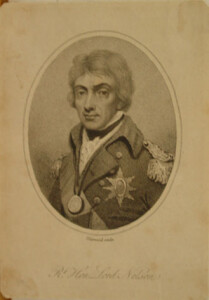 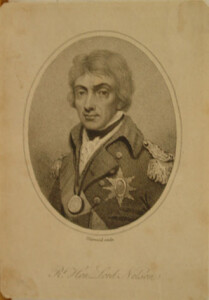 | SHORT DESCRIPTION: Oval portrait, stipple engraving, featuring a bust-view of Horatio Lord Nelson facing slightly left, wearing an undress uniform with the ribbon and star of the Order of the Bath and a single gold medal around his neck. Nelson's right sleeve is empty and hanging by loop from a button on his chest. This image was published in the Universal Magazine of Knowledge and Pleasure, No.24 v.4. November 1805, New Series, page 385. NOTES: Text of article that accompanies the image: A BIOGRAPHICAL SKETCH OF THE LIFE OF THE RT. HONOURABLE VISCOUNT NELSON. WITH A PORTRAIT. Venimus nunc as fortissimum virum, maximique consilii --- Ea que prospere, ei cesserunt non magnitudine copiarum sed consilio quo tum omnes superabat, acciderunt. [Google Translate: We have now the strongest man in the foundation plan --- things are successful, they remain numbers, but by how well all day, actually occurred.] At a time when the best blood in the country is shed for its defiance, it is impossible for the most indefensible of our countrymen to be wholly indifferent to the causes or the measures which have committed us to such hazard. Thus every man, in some degree, is forced, with whatever reluctance, to connect the fate of the individual with the condition of his country. The hero whose name our feeble pen so gladly contributes to immortalize, is no more. He planned, he in great part consummate another splendid victory! But alas! the cypress is so largely entwined with the laurel, that the eye weeps while the heart would fain exult. The mingled sensation is painful in the extreme. The valiant warrior should have survived the moment which is to unseal the fortune or the doom of his country. He has more than once, as by a countermine, blown up the hostile and the insidious operations of those enemies, declared or otherwise, who had taken measures for sapping the very foundations of our greatness: he should have lived to see the perfection of his patriotism, the reward of his devotion, in the end of the troubles which involved his beloved, his grateful country. His ardor and his sacrifice are the more honourable to him as a warrior, because he has never been considered a courtier. Though he even disapproved of an administration, he felt it his duty to struggle to his utmost power for the salvation of his country’s glory. In his expiring eyes might be read the apophthegm of Horace: “Dulce et decorum est pro patria mori” [GoogleTranslate: It is sweet and honorable to die for the fatherland] While the generous combatant this pours out his blood in battle, without allowing himself to enquire into its necessity or expediency, let the governors of the country not forget how great is the responsibility on those who wantonly open the temple of Janus, or unnecessarily delay one hour to shut its gates. The virtue of a senator, and the courage of a soldier, are vainly exerted under and incompotent or a corrupt government. A minister may exultingly display the riches of the country; he undertakes to govern, he may boast of the dominion over those seas, through which that wealth is wafted into his treasuries: for unless his wisdom contribute as much as the sailor or soldier;s sword, to protect what he so highly prizes, he will but awaken envy, create enemy after enemy, and immolate without tnd such magnanimous persons as the one whose loss we have too much reason to deplore. We have a powerful and an inveterate enemy to cope with. He is a furious, and, in many respects, a fortunate emulator of Alexander. He has the ambition of that Grecian, with the disposition of a Nadir Shaw, and an Abdallah, to obtain its gratification; and being a soldier of fortune, like these two latter chiefs, he may be supposed to seek his safety in nearly the same measures, though in different quarters of the globe. It will be in the interest of a civilized plunderer to spare as little as a barbarian plunderer. Agra and Delhi were sacked of more immense treasures than any modern cities contain, tis true, but it was not so much to the advantage of the Eastern conquerors to destroy those thrones, as it would be in a Western, to subvert that of the capital of Britain. It is a folly to estimate the strength of an empire by its riches, rather than by the maxims which are calculated to uphold them. This illustrious Briton was born on the 29th of September, 1758, in the parsonage-house of Burnham Thorpe, in the county of Norfolk. His grandfather was rector of Hillborough, in the same county, where the family had been long resident, and of which living they are, and for many years have been, the patrons. His Lordship’s father [pg 386] the Rev. E. Nelson, married Catherine, daughter of the Rev. Dr. Maurice Suckling, rector of Barsham, in Suffolk, and Woodton, in Norfolk, and one of the prebendaries of Westminster (The Nelsons are, therefore, related to the noble families of Walpone, Cholmondely, and Townshend, his mother bearing the grand-daughter of Sir Charles Turner, bart. of Warham, in the county of Norfolk, and of Mary, daughter of Robert Walpone, esq. of Houghton, and sister to Sir Robert Walpole, first Earl of Orford, and to Horatio, first Lord of Walpole, of Wolerton, whose next sister, Dorothy, was married to Charles Viscount Townshend. The Sucklings have been seated at Woodton, in Norfolk, near three centuries.). By this lady Mr. Nelson has issue eight sons and three daughters, of whom only one son and two daughters are now living; the subject of our memoir was the fourth son. The high school at Norwich possesses the honour of having instilled the first rudiments of education into the mobile mind of this distinguished character, from which school he afterwards removed to that of North Walsham. Captain Suckling, his Lordship’s maternal uncle, was his early and very valuable friend. He was an officer in the sea service, and commanded, first the Raisonnable, of 64 guns, and afterward the Triumph (This gallant officer commanded the Dreadnought, in the West Indies during the month of October, 1757, when, in concert with Captain Forrest, of the Augusta, and Captain Langdon of the Edinburgh, they engaged, off Cape Francois seven French Ships, the of them of the line, one of 50, two of 44, and two of 30 guns. In April, 1775, Captain Suckling succeeded Sir Hugh Palliser as comptroller of the Navy. In 1778, Captain Suckling was elected member of parliament of Portsmouth, but died in July of the same year.). In 1770, he took young Nelson, then only twelve years old, from the above school, and entered him as midshipman on board of his own ship. The subject of altercation, however, with Spain, being adjusted, and the Raisonnable paid off, our young mariner was sent by his uncle on board of a West India ship belonging to the house of Hibbert, Purrier, and Horton, under the care of Mr. John Rathbone, who had formerly been in the king’s service with Captain Suckling, in the Dreadnought. Having returned from this voyage, in July, 1772, Horatio was received by his uncle on board the Triumph, then laying at Chatham. By this voyage to the West Indies, though Mr. Nelson had gained a practical knowledge of seamanship, he had acquired a thorough dislike for the Royal navy, whether from the horror at the contemplation of those scenes of severity at one time, and of excess and vice at another, or whatever might be the cause, certain it is, that it was not without the utmost difficulty Captain Suckling could remove his aversion. This, however, was at length effected, by the firmness and address of his uncle. Among other methods adopted for the accomplishing this desirable end, it was held out to his nephew, that if he attended well to his duty, he should be permitted to go into the cutter, and decked long-boat, attached to the commanding officer’s ship at Chatham: this operated on the mind of the aspiring youth, as was expected, and by its means he became an excellent pilot for vessels of that class, which sailed from Chatham to the Tower of London, and also down to the Swim Channel to the North Foreland. By these short navigation, some of them in most difficult passages, the mind of Nelson acquired that strength and firmness, for which he was so particularly distinguished throughout his subsequent glorious career. A voyage of discovery towards the North Pole having been resolved upon the Race Horse and Carcase, bombs, were ordered in April, 1773, to be fitted out for that purpose; the command of the former was given to the Honourable Captain Constanting John Phipps, afterwards Lord Mulgrave, that of the latter to Skeffington Lutwidge, esq. The object of this voyage was to ascertain the practicability of a North-west passage into the South Seas, or at least to discover how far navigation was possible towards the North Pole, and to make such observations as might contribute to the advancement of the nautical knowledge. Instructions had been given that no boys should be received on board; yet the ardent manner in which young Nelson entreated to be permitted to accompany the expedition, and his officer to become coxswain to Captain [pg 387] Lutwidge, rather than be left behind, struck the commander of the Carcase with such admiration, that he was irresistibly prevailed on to receive him in the above capacity. A friendship of the most generous nature from that moment ever after subsisted between them. The ships sailed from the Nore June 2nd, 1773. In this arduous voyage Nelson greatly distinguished himself, particularly in the beginning of August, when the two vessels were so perilously situated off the Seven Islands, from their becoming suddenly locked in extensive fields of ice (Amidst these dreary scenes, the following circumstance occurred, which shews his wonderful perseverance and cool intrepidity. In these hush northern latitudes, the nights are generally clear: during one of them, notwithstanding the extreme bitterness of the cols, young Nelson was absent from his ship’s company, and every search was instantly made in quest of him, and it was at length the general opinion he was lost; when, as soon as morning dawned, to the astonishment of his messmates, he was discovered at a great distance on the ice, in the act of pursuing an enormous bear with a musket, the lock of which, it seems, being injured, the piece would not go off, and he had therefore pursued the animal in hopes of tiring him, and being enabled to effect his purpose with the butt end! On his return, Captain Lutwidge reprimanded him for leaving the ship without permission and in a severe tone demanded what motive could so possibly induce him to so rash an action? To this the young hero replied with great simplicity --”I wished, Sir, to get the skin for my father.”) for five days, at the end of which, the adventurous navigators were happily freed from the horrid apprehensions of perishing by poplar cold, which, it has been justly observed, appeared too likely to have been realized, as in abandoning their ships, they would have put their safety upon a very precautious contingency. The most northern point of latitude which they reached was 81 deg. 36 min.; when finding utterly impracticable to penetrate any farther, they made for the harbour of Smeerenberg, which lies on the Northwest of Spitsbergen : from this place they shaped their course homeward, and young Nelson returned safe to Orfordness on the 24th of September, having been absent one hundred and fourteen days. A biographer of the late Earl Howe (who, like Nelson, had, at the age of fourteen, shared the perils attendant on a voyage of discovery) says: “Even at this age there was a hardihood and intrepidity about the noble youth that promised much,” but of Nelson we might at this period say, as was of Miltiades, “that his countrymen might now not only hope well of him, but even assure themselves he would be such an one as they found him upon trial.” Scarcely were the two vessels paid off, when our young hero, understanding a squadron was fitting out for the East Indies, exerted his whole interest to be appointed to one of the ships. He has just explored the frigid zone, he was now anxious to pass the torrid; his wishes were gratified. He obtained a birth in the Sea Horse, of 20 guns, commanded by the gallant Captain Farmer (This brave, but unfortunate commander, was afterwards appointed to the Quebec, in which he engaged a French frigate of superior force for upwards of three hours, when, though his ship had taken fire, and he himself was desperately wounded, he would not quit his vessel; in a short time it blew up with a dreadful explosion!). In this ship, Nelson was stationed in the fore top but afterwards he was placed on the quarter deck. Thus we may perceive that this illustrious character did not arrive at those honours which have of late been so liberally bestowed, but by a long series of arduous and probationary services. During the period Mr. Nelson served in the Sea Horse, he visited almost every part of the East Indies, from Bengal to Bussora. He, however, became so seriously indisposed, that Sir Edward Hughes, who highly esteemed him, resolved to send him to England, in the Dolphin, of 20 guns, Captain James Pigot, whose kindness and attention were highly instrumental in preserving that life, which became so dear to his country. On the 24th of September, 1776, the Dolphin being paid off at Woolwich, Mr. Nelson, two days after, received an order from Sir James Douglas, then commanding at [pg. 388] Portsmouth, to act as Lieutenant of the Worcester, of 64 guns, Captain Mark Robinson, who was under sailing orders for Gibraltar, with a convoy; in this he remained until the 2d of April, 1777. The commander, Captain Robinson, placed the greatest confidence in young Nelson, and was often heard to say, that he felt equally easy during the night, when it was Nelson’s watch, as when the oldest officer on board had charge of the ship. Mr. Nelson, at this time had not attained his 19th year. On the 8th of April, 1777, Mr. Nelson soon passed his examination for the rank of lieutenant, and on the ensuing day received his commission as second of the Lowestoffe, of 32 guns, Captain William Locker. He immediately sailed for the Jamaica station. But the active mind of Nelson could not endure that leisure which he found in a stationary ship, and he solicited an appointment to the commander of a schooner, tender to the Lowestoffe. In this little vessel he ran through all the intricate passages of the King’s Islands, on the northern side of Hispaniola, and became a complete and most skilful pilot here. Every minute incident in the life of so great a character, becomes highly interesting. The following anecdote cannot, therefore be considered unimportant, as it shews the intrepidity and ardour for distinction which is so prevalent in the navy. In a strong gale of wind and a heavy sea, the Lowestoffe captured an American letter of marque. THe captain ordered the first lieutenant to take possession of her, which he accordingly attempted without effect, owing to the tremendous sea. Captain Locker then explained, “Have I no officer who can board the prize?” In this the master ran to the gangway, in order to jump into the Boat. Nelson flew and stopped him -- “It is my turn now,” cried he, “if I come back it will be your’s!” How justly has it been said that the energies of Nelson’s mind were ever in proportion to the dangers and difficulties which surrounded him. On the arrival of Rear-Admiral Sir Peter Parker at Jamaica, in 1778, he appointed Lieutenant Nelson third of the Bristol, his flag ship, of which, by rotation, he became the first: indeed he concluded his services in the rank of lieutenant in this ship. On the 8th of December, the command of the Badger brig on this station was given to him. He was shortly ordered to protect the Mosquito shore, and the Bay of Honduras, from the depredations of the American Privateers. This he did so effectually as to gain the admiration and esteem of the settlers, who expressed their sense of his services by a vote of thanks. Whilst Captain Nelson commanded the Badger, his Majesty’s ship Glasgow, Captain T. Lloyd, a few hours after her arrival in Montego Bay, took fire; it was owing to the great exertions and presence of mind of Captain Nelson, that the whole of the crew were saved from perishing in the flames. On the 11th of June, 1779, Captain Nelson obtained his post rank, and was appointed to Hinchinbroke. At this period, Count D’Estaing threatened Jamaica with a numerous fleer and Army. The command of the batteries at Port Royal was entrusted to Captain Nelson. It was a critical and highly important post, being the key to the naval force of the town of Kingston, and to the seat of the government at Spanish Town. In January, 1780, an expedition being resolved on, for the reduction of Fort Juan on the river St. John, in the gulph on Mexico, Captain Nelson was appointed to superintend the naval department, and Major Polson the military. To further the object of this expedition, Captain Nelson quitted his ship, and superintended the transporting the troops in boats, one hundred miles up this river, a river which none but the Spaniards, since the time of the Buccaneers had ever navigated. Major Polson bore ample testimony (to General Dalling) of the exertions of his brave colleague, who, after storming an outpost of the enemy, situated on an island in the river, constructed batteries, and actually fought the Spaniards with their own guns. The object of the expedition was accomplished, but the health of our gallant countryman had, by his great exertions in this climate, become very considerably impaired; and having been appointed to the Janus, of 44 guns, at Jamaica, he took his passage thither in the Victor sloop to join his ship. Sir Peter Parker perceiving the state of his friend, entreated him to retire to his Penn; but finding, notwithstanding every medical assistance, that his health continued to decline rapidly, he was constrained to return to England, which he did in his Majesty’s [pg. 389] ship Lion, commanded by the Hon. William Cornwallis, to whose care and attention Captain Nelson might be said to owe his life. After his arrival, he was eleven weeks at Bath before he recovered the use of his limbs. In August, 1781, he nevertheless assumed the command of the Albemarle, and passed the whole of the winter in the North Seas. In April, 1781, Captain Nelson sailed with a convoy for Newfoundland and Quebec, under the orders of Captain Thos. Pringle. WHilst cruising off Boston, he was chased by three ships of the line and the Isis frigate, and owing to their superior sailing, they were gaining fast upon him: at this moment, Captain Nelson resolved to trust to Providence, and his own experience in pilotage, and run his ship among the shoals of St. George's Banks: The line of battle ships became alarmed, and immediately quitted the pursuit; the frigate, however, continued it, and having approached within little more than gun shot, Captain Nelson prepared to give battle : the enemy on this (perceiving the main-top-sail laid to the mast) thought proper to tack and sheer off. In October, 1782, Captain Nelson sailed from Quebec with a convoy to New York, where he joined Sir Samuel Hood, and afterwards sailed with him to the West Indies, and was actively employed till the peace. Captain Nelson was soon ordered to England, but directed in his way to attend Prince William Henry, on his visit to Havannah. On the last day of July, 1783, the Albemarle was paid off at Portsmouth, and in the ensuing autumn Captain Nelson went to France, where he remained till the spring of 1784, when he took command of the Boreas frigate, of 28 guns, and was ordered to the Leeward Islands. Captain Nelson had under him the Duke of Clarence, who commanded the Pegasus. On this station, a misunderstanding took place between him ans the governors and custom-house officers, on the subject of the right of the Americans to trade with our West India islands. It will be sufficient to observe, that an act of parliament has since confirmed the propriety of Captain Nelson's conduct. On this command he remained till June, 1787, when he sailed for England. In the month of March of this year he was united to Frances Herbert Nesbit, widow of Dr. Nesbit, of the island of Nevis, daughter of William Herbert, esq. senior judge, and niece to Mr. Herbert, president of that island; the bride being given away by Prince WIlliam Henry. By this lady Lord Nelson had no family, but Lady Nelson has a son now living, by Dr. Nesbit. He is a very gallant officer, and served under his father-in-law with great distinction. Captain Nelson retired with his lady to his native place, at Burnham Thorpe; and never, perhaps, was a man better formed for the enjoyment of domestic happiness, possessing the most gentle temper and the most affectionate heart. But duty to his country, and the acquisition of renown, were objects to which he sacrificed every other consideration. In the year 1790, therefore, on the dispute to relative to Nootka Sound, he left his retirement, and offered his services; but his endeavours to get actively employed were ineffectual till the 30th of January, 1793, when Captain Nelson was appointed to the Agamemnon, of 64 guns(Of this ship's company, a great part was raised in the neighborhood of Burnham Thorpe. The general opinion of his conduct and abilities as an officer was such, that gentlemen were desirous to place their sons under his command, and some obtained the favour: among those whom he was obliged was the Rev. Mr. Bolton, his relation, and the Rev. Mr. Hoste, and Witherhead, who were permitted to enter their sons midshipmen on board the Agamemnon. It has been justly observed, if these gentlemen wished to give their sons an insight into their profession, founded upon practice and example, they could not have selected a fitter master.), in a manner which considerably soothed his feelings, indignant as he was at the coolness with which his offers of service had previously been received. He was soon placed under that noble officer, Lord Hood, then appointed to command in the Mediterranean. At Toulon and at Bastia, Captain Nelson greatly distinguished himself. At the siege of Calvi, in July and August, 1794, he behaved with the greatest intrepidity. Here he was unfortunately deprived of the sight of his right eye, by a shot from the enemy's battery striking the upper part of that which he commanded, and [Pg 390] driving sand into his face with prodigious force. It is impossible for us to record all the brilliant exploits of this veteran. Scarcely a gazette appeared , but it contained an account of some service performed, some gallantry displayed, some enterprise undertaken : if ships were to be cut out of harbours, if the hazardous landing of troops was to be effected, Horatio Nelson's name always stood foremost with his brave officers and crew. The nation was not insensible to these exertions; the two houses of parliament voted a resolution of thanks, which was particularly flattering to Captain Nelson's feelings, and shewed the estimation in which his services were held. In October, 1794, Lord Hotham succeeded Lord Hood in the command of the Mediterranean, and honoured Captain Nelson with his greatest confidence. In the actions which took place with the French fleet on the 13th and 14th of March, as also on the 13th of July, 1795, Captain Nelson highly distinguished himself. Admiral Hotham afterwards appointed him to co-operate with Austrian General De VIns, at Vado Bay, on the coast of Genoa. On this service he remained till Admiral Hotham was superseded by Sir John Jervis. In April 1796, the Commander-in-chief so much approved of Captain Nelson's conduct that he was directed to wear a distinguished pendant; and in May he was removed from his favourite old ship, the Agamemnon, to the Captain, of 74 guns: on the 11th of August, a captain was appointed under him. It was a general observation at this time, that before Nelson quitted his old ship, he had not only fairly worn her out (*When the Agamemnon came into dock to be refitted, in October 1796, we are all informed there was not a mast, yard, sail, nor any part of the rigging, but was obliged to be repaired - the whole being cut to pieces with shot; her hull had long been kept together by cabled served round.), but also had exhausted himself and his ship's company. His constitution, like that of the great Turenne, was originally very delicate, but from habits of active service he was enabled to support great fatigue. His Strength was, however, much impaired previous to Lord Hood's returning to England. In December, 1796, Commodore Nelson hoisted his broad flag on board La Minerve frigate, Captain Greorge Cockburne, which ship, with others, were dispatched to Porto Ferrajo, to bring the naval stores lying there to Gibraltar, of which the fleet at that time stood in great need. On the passage, in the night of the 19th of December, the Commodore fell in with two Spanish frigates, one of which he captured, after a hard fought action of three hours. She proved to be La Sabina, of 40 guns and 286 men, Don Jacobo Stuart, captain. On the 12th of February, Commodore Nelson fell in with the whole Spanish fleet, off the mouth of the straits of Gibraltar, through which he passed safe, although chaced by two line of battle ships; he arrived just in time to give the necessary information to Sir John Jervis, who was stationed off Cape St. Vincent. Commodore Nelson shifted his pendant on board his former ship, the Captain, of 74 guns, Ralph W. Miller, esq. commander. Scarcely had the Commodore effected this, when the signal was thrown out for the British fleet to prepare for action: the ships were directed to keep in close order in the night, during the whole of which, the enemy's signal guns were distinctly heard. The morning was dark and hazy: at half-past six the Colloden discovering five sail in the S.W. quarter, the signal for the fleet to prepare for battle was repeated: at eight o’clock the squadron was ordered to form in close order. A few minutes before ten the enemy’s fleet was visible to the whole squadron. The ships first discovered by Culloden, were at this period separated from their main body, which was bearing down in some confusion to join the separated ships from the enemy’s fleet, before the main body could arrive to their assistance; but the admiral afterwards formed the fleet into a line of battle a head as most proper. The signal was then given to pass through the enemy’s line: this bold manoeuvre was quickly executed; the Spanish admiral, who was now to windward with his main body of 18 ships of the line, 9 being [pg 391] ;eeward: these nine, however, made a movement to join the former, by passing through, or to the leeward of the British line. Commodore Nelson being stationed in the rear, immediately perceived their intention; in order to frustrate it, he wore and stood towards the enemy. By this movement the commodore found himself alongside the admiral’s flagship, the Santissima Trinidada, of 126 guns, a ship of four decks, presumed the largest in the world. This did not, however, deter Commodore Nelson from engaging his colossal opponent, although he had to contend not only with her, but with her seconds ahead astern, each of three decks! While maintaining this unequal combat, which excited the admiration of all his friends, who were anxiously flying to his support, the Culloden, Captain Troubridge, and the Blenheim, Captain Frederick, opportunately arrived. The Spanish admiral was staggered at the intrepidity of the British, and perceiving several other English ships fast approaching, he relinquished his hopes of joining his ships to leeward. Commodore Nelson after this became closely engaged with a spanish three decker, bearing an admiral’s flag. Captain Collingwood, in the Excellent, hastened to his relief, but before he could come up, the spaniard’s mizen mast fell overboard, and she got entangled with her second, the San Nicholas, a two decker, of 84 guns. Commodore Nelson had nearly expended the whole of his ammunition; his vessel had lost her fore-top-mast, and received such considerable damage in her sails and rigging, that she was very nearly rendered hors du combat. A most rigorous fire was, however, kept up on the commodore’s new opponent, who was within pistol shot. The commodore;d men now dropped fast, and from the state of his vessel, a further continuance of the contest appeared impossible. Commodore Nelson’s energy was strengthened by his perilous situation; he resolved on a bold and decisive measure, and determined to attempt his opponent sword in hand. The necessary steps being taken, his ship was laid on board the enemy, her spiritsail yard passed over the enemy’s poop, hooking in her mizen shrouds. The word Board! Being given, the officers and seamen destined for this perilous duty, headed by Lieutenant Berry, (together with a detachment of the 69th regiment, commanded by Lieut. Pearson, doing duty as marines on board) passed with rapidity on board the enemy’s ship, and in a few minutes the San Nicholas was in the possession of her intrepid assailants. The commodore’s ardour would not permit him to remain an inactive spectator of this scene; his motto has always been Quo res cunque cadunt unum et commune periculam Una salus ambobus erit. (Whatever fall for one common danger. One safety. - Google Translate) He accompanied the party in this attack, as if by magic influence, passing from the forechains of his own ship into the enemy’s quarter gallery, and thence through the cabin to the quarters deck, where he received the sword from the dying commander, who had been mortally wounded by the boarders. The sword he afterwards presented to the city of Norwich. Scarcely was this hard-earned conquest secured, but a more arduous task presented itself. His former opponent, the San Josef, a three decker, now sorely annoyed with musketry those who had boarded the San Nicholas. Two alternatives only presented themselves - either to quit the prize, or instantly to board the three-decker. Confident in the bravery of his seamen, the commodore was not long in resolving on which step he should take. Directing an additional number of men to be sent from the Captain on board the San Nicholas, the commodore put himself at their head exclaiming - “Westminster Abbey or glorious victory!” Success in a few minutes crowned the enterprise: the Spanish commander prostrated himself before our gallant hero, and delivered up his sword. It has been very properly observed, that in estimating the services of this lamented hero, it is not a single achievement we admire, in which, perhaps, good fortune had at least as great a share as good conduct, but in his life we trace a series of successes, for the greater part planned with as much judgment as spirit. Commodore Nelson shifted his pendant on board Minerve, and from thence to the Irresistible, Captain Mortin, his own ship being incapable of further service till refitted. As some reward for his gallantry, he was invested with the insignia for the order of the [pg 392] Bath, and the gold medal from his Sovereign. And was also presented with the freedom of the city of London. But the most pleasing reward this great man found, was in the universal applause and admiration of his countrymen. In April, 1797, Sir Horatio hoisted his flag as Rear Admiral of the Blue, and was detached to bring down the garrison of Port Ferrajo. On the 27th of May, he shifted his flag to the Theseus, and was appointed to command the inner squadron at the blockade of Cadiz. During this arduous service, his personal courage shone with full lustre. In the attack on the Spanish gun boats, on the 3d of July, 1797, he was boarded in his barge, which contained only ten men and the coxswain, accompanied by Captain Freemantle. Don Miguel Tyreson, who commanded the Spanish gun boats, in a barge rowed by twenty-six oars and thirty men, made a most desperate effort to overpower Sir Horatio and his brave companions. The contest was long doubtful; they fought hand to hand with their swords, eighteen of the Spaniards being killed, the commandant and all the rest being wounded : the rear admiral succeeded in carrying this superior force. Sir John Jervis, in his letter to the admiralty on this subject, says --”Rear Admiral Nelson’s actions speak for themselves; any praise of mine would fall very short of his merit!” Though the enterprise against Santa Cruz did not succeed, his Majesty’s [arms?] acquired great lustre, and greater intrepidity was never shown by both the officers and men. Here it was the gallant officers and men. Here it was the gallant admiral lost his right arm by a cannon shot. The life of Sir Horatio was providentially saved by his son-in-law, Lieutenant Nesbit, on the night of the attack. The admiral received his wound soon after the detachment had landed; and while they were pressing on with the usual ardour of British seamen, the shock caused him to fall to the ground, where for some minutes he was left to himself, until Mr. Nesbit, missing him, had the presence of mind to return; when, after searching in the dark, he at length found his brave father-in-law weltering in his blood, on the ground, with his arm shattered, and himself apparently lifeless. Lieutenant Nesbit immediately applied his neckerchief to the admiral’s arm, to stop the father effusion of blood, and carried him to the beach, where, with the assistance of some sailors, he conveyed him into one of the boats, and put off to the Theseus, under a tremendous, though ill-directed fire. The next day after the rear admiral had lost his arm, he wrote to Lady Nelson, and in narrating the foregoing transactions, says: “I know it will add much to your pleasure, in finding that your son, Josiah, under God’s providence, was instrumental in saving my life.” This same night, at ten o’clock, the admiral’s arm was amputated on board the Theseus: he immediately after began his official letter, and finished it by eleven. On Admiral Nelson’s return to England after this enterprise, it was not till the 13th of December, that the surgeons pronounced him fit for service. On his first appearance at court, his sovereign received him in the most gracious manner, and expressed his regret that the state of his health and mutilated person would doubtless deprive the nation of his future services. Sir Horatio replied, with a dignified emphasis, “May it please your majesty, I can never think that a loss which the performance of my duty has occasioned; and so long as I have a foot to stand on, I will combat for my king and country.” Shortly after the gallant admiral, as some small recompense for having devoted himself hitherto to the service of his country, and as compensation for the hardships and wounds which he had received in that service, had a pension granted to him of one thousand pounds per annum. Previous to the issuing of this grant, a custom required he should state his services to his Majesty. In narrating the services and life of a character of this nature, our readers will not be surprised to hear, that we find it utterly impossible to do justice to his subsequent career, within those limits, we are constrained to observe. We therefore defer, till our next, the completion of our memoir, a delay which our readers will have less reason to regret, as it will enable us to avail ourselves of the information of those, whose feelings are too poignant to allow them to communicate it at this moment. | CL29337 |
Created 2026 by Don Barker, CBMM volunteer, for the Chesapeake Shipbuilding Project. shipbuilding@sailingworkboats.es